Thoughts About Christians Far Away

For Lent this year at Old South, we are “Walking and Praying with Christians of the Middle East” through a study offered by Churches Together Britain and Ireland. A small group from Old South gathers for Bible Study on Tuesdays and then each Sunday, we include a different group in our prayers—Christians in Syria, Egypt, Iraq, etc.

Through this study, we are learning some challenging lessons. It is extremely difficult to understand what it means to live as a Christian in many areas in the Middle East, where being a Christian makes one a target for violence and murder. It’s almost impossible to appreciate the situation of living constantly in harm’s way or choosing to flee from one’s home, simply because of one’s professed faith. It’s hard to know how to respond to the targeting of Christian communities that go back to the earliest years of the Christian Church.

Many questions are being raised, yet few answers are clearly apparent. Where is God in the midst of such suffering? What would I do if I lived in a place where the Islamic State had taken control, or was close to doing so? What would I do if I felt threatened? In the face of violence, would I be able to profess my faith, or would I try to hide it? What can we meaningfully do, given that we live so many miles and miles away? Do the prayers we raise in support of threatened Christians make any difference?

For Christians in Central Maine, it’s mind-boggling to think about the lives that Christians lead on the other side of the world. As we gather on Sunday mornings under our tall steeples near the middle of towns and cities, we rarely think about the ease with which we practice our faith. In this season at Old South, though, we are increasingly aware of how much we take for granted.

As our eyes are opened, though, we are finding ourselves in an unsettled place. My hope is that, ultimately, this will be a good thing. Although it is extraordinarily unlikely that any of us will face any sort of threat of the kind of the Islamic State, we are becoming increasingly sensitive to our own minority status. Will our decreasing numbers cause us to weaken and dissolve under the weight of disillusionment, or will we become renewed and strengthened in our mission to share the love of God through Jesus Christ?

Through our Lenten study, we are learning meaningful stories of those who are, despite the threats, living the faith and sharing the love of God. We are inspired by the stories of those who are reaching out and caring for the poor as well as those who have been displaced by violence. We are encouraged by those who seek to love their neighbor, by those who remain grounded in hope, no matter what is happening around them.

And we pray that we will also be renewed and strengthened for the journey, that we will find meaning and hope in the prayers that we raise for our threatened sisters and brothers in the faith, and that we will try not to take for granted the comfort with which we practice our faith. We encourage other Christians to join us.

Posted in Other Denominations/Christians | Leave a comment

The Flight From Church

I was having dinner with some friends recently. Part of the conversation over our Mexican entrees involved the tale of a visit of a distant cousin, with whom one of my friends had recently connected. During the reunion of these distant cousins, the conversation turned to religion. Years ago, the Irish-dominated family was strongly attached to the Roman Catholic Church. But now, to the extent that these two women could figure, sharing information about the various relatives that each knew, not one family member is still attached to the Church. Not one.

Over the last several years, I’ve found myself thinking a lot about the changing dynamics of the church, and what it means not only to find increasing numbers of adults who have left the church, but then to ponder the successive waves of generations, all increasingly disconnected from church and religion.

In this part of the world, the flight from church is clearly obvious. The Roman Catholic church building in Oakland, Maine has a large “for sale” sign out front. Just a little further north, in the town of Madison, the Congregational Church held its last worship service at the end of December (the building will become an “event” space for weddings, etc.).

I found myself thinking about the flight from church in a rather strange place not too long ago—at a local synagogue. I was at the bar mitzvah service for the son of a close friend. In this particular family, the mother grew up Christian and the father in a sort of culturally Jewish family. The family is not religious, although their older daughter flirted with Christianity for a while. But, the son decided, a couple of years ago, that he is Jewish, and that’s how his journey to become a bar mitzvah began—with a decision completely his own.

In the midst of the long Saturday morning service, I noticed that most of those in the congregation were guests of the family. Only a handful of the small, local Jewish population was present. The rabbi noted the significance of this young man’s decision, and the consequences of that decision—one of them being to support fully the tiny Jewish community in central Maine.

When children are raised in environments where they are “empowered” to follow their own path of spirituality, but the parents do not lead by example, how many of them actually end up connecting with organized religion? Though it was quite moving to witness the bar mitzvah of a young man who had made a clear choice—a decision all his own— it also seems clear that his story is nowhere near typical.

The flight from the Church is obvious, yet those of us still within the tradition are mostly still in a state of denial regarding our condition, and our future. We like to blame the culture of which we are part (Sunday morning sports practices, for example) or we convince ourselves that it’s someone else’s problem (like the pastor’s) or that all we need is the right program or slogan (a youth group, for instance). The movement away from the Church, though, is very real and very much a movement with energy and momentum. A certain pastor, or a certain program, is just not going to change the dynamic.

While I certainly don’t think that we should just give up (we are always a people of hope), we should be thinking and praying about what it will be like to be a sort of “remnant” community. How will we function—how can we function—if we are just a tiny group? Can we embrace the “consequences” of being the faithful few, supporting and encouraging each other in deep and abiding ways, even if all we have at worship is a handful of people? Will we find the courage to embrace our smallness and to find strength in our faith, regardless of how many are with us on the journey?

In places like Central Maine, where churches are not just struggling but closing, these are important questions. It’s time that we let go of those memories of full sanctuaries and, instead, embrace our faith, and learn to think about it in new ways—ways that just might lead to something completely unexpected. Like Easter.

Posted in Other Denominations/Christians | Leave a comment

The Lasts

My daughter is a senior in high school. Now that she’s officially got herself into college (Vassar) and she, her father, her brother, and I know that she’ll be going away, we’ve begun the parade of “lasts”—her last home high school swim meet, her last high school state swim meet, her last home YMCA swim meet (notice a theme?), etc. Her last YMCA state swim meet is this weekend, and here’s a non-swim related “last”: her last “biggest/shortest” concert (a concert that involves all of the strings students in the Waterville school system) is next Wednesday.

The rest of the school year leading up to graduation will be full of “lasts,” some more significant than others. But, there will be plenty of them.

I’ve been thinking a lot about lasts. During a recent clergy breakfast, a colleague was wondering about lasts in relationship to the church that she serves. Is this the last few months that she will be with them? Is this the last year that they will be able to exist as a church?

At Old South, too, I’ve been thinking about lasts. Although our situation is not nearly as dire as my colleague’s, I do wonder, as we celebrate our 225th anniversary, if the church will be around for the next big anniversary. Does the church have another 25 years or is the 225th our last milestone anniversary?

Churches have a hard time with “lasts,” and that is understandable.   Especially for those of us who have some memory of full church sanctuaries, it is difficult to accept that our circumstances have changed so dramatically in a relatively short period of time, on our “watch,” so to speak. Talking to church members whose churches have closed, I am taken aback by the language of failure, with good church people talking about closure with words like, “Our church failed.”

But, as I think about my daughter’s “lasts,” many of which are bittersweet, I’m also increasingly aware of the life that is a part of them, that she is living a life, though connected to me, is not controlled or engineered by me (even if I wish it to be!). The “lasts” that she is experiencing, in and of themselves, don’t express success or failure; they are part of her journey of life. They reflect choices that, though selected by her parents initially (when she was nine, she didn’t sign up for the swim team herself, after all), are now hers. Even as her parent, I’m in not so much in “control” of the path and the journey of her life, as I am a participant, a loving guide, an encouraging presence. The life that she is living is hers, connected yet also significantly separate, moving in its own direction.

I’ve been thinking about this dynamic in relation to my connection to church. I am less in control of where and how the path of the church will unfold, and where it will end. My role is not so much to control, as to participate, love and encourage. My place is to be a part of a good church, a church that demonstrates and lives out God’s love and hope, even if that means that we are on our own series of “lasts.”

Even if Old South does not manage to make it to its 250th, I’d like to think that we will never think of our church as a “failure.” Instead, we will think of our good witness, and our efforts to live out the love, hope, peace and joy of God, through Jesus Christ and the Holy Spirit. If we remain true to the Gospel, we and the church of which we are part, will never be a “failure.” Even if we come to a place where we close our doors and shut down.

Who knows what life may come next? It may be better and more exciting than we can imagine.

To believe is to trust and to trust is to know that God lives, and God lives in our midst, even if we are—consciously or unconsciously—living out a series of “lasts.” All I or we can do is to share the love of God with reckless abandon. We may not attract others, or enough others, to keep this church called Old South running into the indefinite future. But we are still church and our witness still matters.

As I am discovering with my daughter, some lasts are happy, some are sad, and some are both. But they are not bad and they certainly are not failures.  They are part of the journey of life. They are part of the journey of faith.


Posted in History Lessons | Leave a comment

The Builders

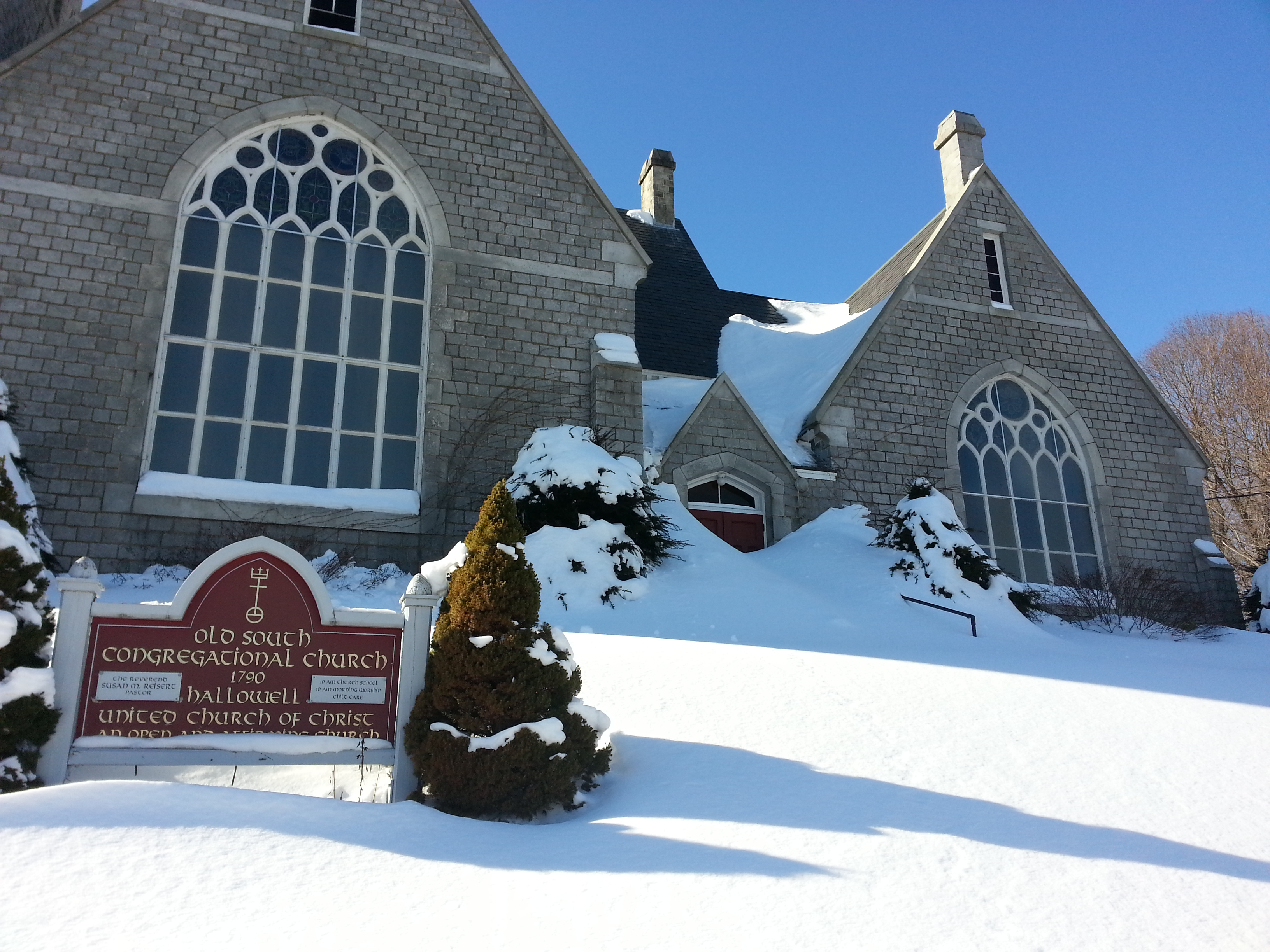
This month, we at Old South are celebrating the 225th anniversary of the gathering of Congregationalists in Hallowell, Maine. As we contend this month with another very snowy Maine winter, and the piles of snow that have just about completely covered the primary entry door of our sanctuary building (when we are able to have worship this winter, we are meeting in the parish house across the street),

20150213_135450

it’s almost overwhelming to think about the difficulties of starting a church in the midst of winter in Maine. At a recent Sunday worship service, someone quipped, “If there’s one time of year when you really need God, this is it.” That is certainly true. When the wind is howling, the snow is blowing, the cold is so biting and brutal and you can’t even remember the last time the temperature outside went above 30, the warmth of the Spirit and the warmth of the gathering of followers of Christ are especially meaningful.

We are taking special notice of our anniversary with “faith stories” offered during worship. In these faith stories, several long-time church members share their own history with Old South. While this month is certainly celebratory, there’s an element to our anniversary that taps into my “worrying place,” an element that has highlighted one of the greatest challenges to being the church in these days, and how to think about the church of the future—and not the far away kind, but the relatively near future.

In observing our anniversary, I’ve strongly encouraged those who are offering a faith story, to focus on faith and their connection to the church. I want to hear more about meaning than history lecture. What is that keeps them connected to this church, and what has it meant to them as they have weathered the storms, as well as the joys, of this earthly life?

Not surprisingly, perhaps, but in this church where the average age is probably around 70, to talk about church and God is to talk about the building, the bricks and mortar, the walls, the roof, etc. That is where the meaning is. It’s in the actual, physical structure of the church building. Faith can be found in the nurture and care of the building—in the repair of the leaky roof, in the painting of the walls, in the replacement of worn out furnaces, and so on.

The problem, of course, is this is not what makes sense to anyone younger than, say, forty. Even for myself, just a hair over the age of fifty and at the very tenuous edge of the baby boom generation, while church buildings are special to me, I don’t actually find in the building itself my connection to faith. A church sanctuary may inspire me to be in awe of the divine, but it doesn’t, in and of itself, fill me with a sense of belonging to my Creator.

So we find ourselves in a tricky place. Maine is the oldest state in the country. The “Builders” and the way they view and experience the world is very much a part of church life, as well as other facets of life. But, what kind of future is this “building-focused” faith ushering in? And, what kind of future should a church try to envision when the demographics suggest that the only growing age group is that of retirees?

While I am honestly deeply moved by the stories of long-time church members, their commitment and efforts to keep this church—including its building—up and running, I can’t help but worry about what these efforts have wrought. Will this church be able to broaden its understanding of faith, to make room for other expressions of faith and faithfulness?  Or, will we enjoy enough of a steady stream of retirees, that we won’t need to worry, at least for a while, about changing our ways?

In reading some of the history of this old, old church, I am reminded that the people of God have weathered many storms, and have managed not only to live through, but even to thrive in the coldest and snowiest of winters (and many of them without fleece!). The challenge seems always to have been, as it continues to be, to appreciate that this church is not simply about the walls that protect us from the cold, but about the gathering of the people inside, and the acknowledgement of and the engagement with the Holy Spirit who gathers with us and inspires us, always, to be more than we think we can be.

Posted in Buildings | Leave a comment

In the Cold, Cold North

A few weeks ago, I came upon this humorous cartoon:

I was thinking about that cartoon yesterday afternoon, while I was snowshoeing near our house in Belgrade, Maine:

20150207_151302

There I am in front of our boat house. I’m standing on a pile of well-packed snow on top of Great Pond. Walking on water!  I’m not sure if this experience makes my faith any stronger, but life in church is a challenge at this time of year– this winter especially.

It feels like it snows just about every other day.  Our driveway feels like a tunnel, with its tall banks of snow on both sides.  And, it’s cold.  For the next week, the highest temperature is predicted to be on Tuesday, when it should reach a balmy high of 27!  We’ll be dreaming of 27 next Saturday, when the predicted high is 8.  Yes, 8 lonely degrees.

At church, the weather is getting to be a problem.  It begins to take a toll on people, on their bodies and spirits.  There are a few who end up staying away from worship, and other church activities.  It’s too cold, too slippery.  There’s snow everywhere.  Travel can be dangerous, as snow coats roads and snow banks pile up at every intersection.

For those who do make it to worship, it’s a cheery and warm environment, a celebration of the brave and hearty.  We share stories of our latest snow adventures, mostly having to do with snow removal and the occasional furnace failure.  Like other Maine mainline churches, Old South is a church mostly of older people.  Maine in general is a state of older people (Maine has the highest median age of any state in the U.S.).  So, it’s a challenge to be a church in winter, where many of our worshippers have a hard enough time getting around when there’s no snow at all.

In the cold of winter, walking on (frozen) water is not so impressive a feat, but living as people of faith in this harsh climate can seem something along the lines of impressive, though it seems odd to think in such ways.  It’s not just the weather that provides an inhospitable climate, but the cultural and community climate as well– and that’s not just a seasonal problem.

So despite our aging population and the declining number of Christians, we walk on our own walk of faith, bravely trying to follow where Christ is leading us, even when it’s a cold, lonely business.

Posted in Maine Cautionary Tales | Leave a comment

We Must Sing a New Song

The Maine Conference United Church of Christ is the midst of implementing a new governance and staffing structure. I recently attended a meeting of the new Mission Council, which is intended to serve as the leadership council of and for the Conference. This new 12-member Mission Council is full of thoughtful and devoted Maine United Church of Christ members, with lay and clergy people who know the conference and are committed to its future.

But, that doesn’t mean they (at least a few of them) don’t drive me crazy.

During our recent meeting, only the third meeting of this new group, we started to talk about the joys and challenges of being the church in the twenty-first century. No surprise, but the conversation turned quickly to just the “challenges,” and then from there, out came all of the same old story, the same old refrain, of what’s keeping people from our sanctuaries on Sunday mornings:
• Sunday sports practices and games
• the competition we face on Sunday mornings
• “It wasn’t like that when I was young.”
• “Why can’ they leave Sunday mornings alone?”

It takes a lot of effort for me not to scream when I hear the same old parade of “woe is me/us” scenarios. It’s one thing to hear such things at the local level, especially among the older members of an individual local congregation—who can really blame them for feeling that the world has completely changed? But to hear all of the same, sad, sorry, tired old refrain from leaders in the church, well that’s especially frustrating, and heartbreaking.

If we can’t figure out how to sing a new song, we are just continuing the death spiral. If we can’t figure out how to look at ourselves and listen to ourselves, honestly and deeply, this isn’t going anywhere. We might as well start the dirge and plan the funeral.

At meetings such as the one I attended, I wish I could record the litany of woes and then make them listen to themselves. One of the dimensions of this same old list of miseries, is the curious notion that these people somehow have failed to appreciate: If the only reason that people came to church in the 1950s and 60s is that they had nothing else better to do, what does that say about us? What does that say about our church?

No one is forcing or coercing people to take their kids to sports practices on Sunday mornings. There is no state law that people must go to brunch and read the New York Times instead of attending Sunday morning worship.

It is absolutely critical for us to understand that people, in their free time, do things that are meaningful to them. And, for lots and lots of people in the Northeast especially, meaning is no longer found in the church.

That’s about us, not them. We need to adopt a new song, and rediscover our reason for being, and then to spread the news—knowing full well, and accepting, that we exist in an environment where many things compete for attention. And, that’s good for us. It may not feel that way, but this is good for us.

We need to figure out why we have stayed connected to the Church, why it holds meaning for us, and then to find new ways of spreading the news—instead of relying on societal and cultural pressure to do the work for us. When we rely on society to help us out, we become lazy evangelists. And, more than that, we become disconnected from why we remain committed to the Church.

We need to stop singing the same old sad song, and learn a new one—a song of the love of God, the grace of Jesus Christ, and the abiding and trustworthy strength and guidance of the Holy Spirit. We need to find the courage to let go of the fifties and sixties, and the grace to say boldly, “Goodbye and good riddance.” We are on to something new, a new song.

Posted in My Life as Pastor, Studies, Demographics, Reality | Tagged | Leave a comment

What Are We Worshiping? Part Two

Good News to share this week.

Last week, I wrote about my concerns that good church folk may be worshiping their building more than their Savior.

At Old South this winter, we are worshiping in our parish house, located across the street from our church building. The plan to move worship was based on two factors. The first was an attempt to curb our demand on fuel. And, the second was in recognition that our building, tucked neatly into a steep hill, is not an easy building to get into (or out of) during the often snowy and icy months of January and February.

When the Oversight Committee announced the change last fall, a couple of people were—and I don’t think this is hyperbole—distraught at the prospect. Worship outside of the sanctuary would not be worship at all, they declared. I asked these folks just to try it. If, in fact, worship did not feel like worship, we could move back over to the church building. No problem. After all, it’s fair to say that the parish house is not the most “church-like” of buildings. It is utilitarian and useful, to be sure, but it’s not anything like Old South’s grand and lovely sanctuary.

We’ve had two weeks of worship in the parish house and already there’s talk about how to move this parish house worship experience into the sanctuary—when it’s time to move back. Even one of the more vocal doubters has indicated a clear liking of this new experience. Astonishing and wondrous. Good news, indeed.

What’s so great about worshiping in the parish house? The congregation must sit closer together—and it turns out, they like it! Some people have admitted to meeting people they’ve never met before—even though they’ve been sharing the same church experience for years—and they like it! The choir is now part of the congregation as well. And, that too, has been greeted with enthusiasm. Probably the most heartwarming of this new choir arrangement is a relationship between a grandmother and her grandson.

We have a young woman who attends Old South with her young son. The grandmother also attends Old South and sings in the choir. The grandmother and grandson usually only see each other on Sundays, and the grandson clearly loves being with, and physically close to, his grandmother. In the sanctuary, though, the choir and the congregation are far apart. The grandson often gets agitated and is unhappy when his grandmother is up in the choir loft. Last Sunday, in the parish house, the choir sat in the congregation. And that meant that the young grandson could sit right next to his grandmother all through the beginning of the service (until it was time for him to go to Sunday School). As his grandmother was singing the anthem, the look of wonder and pride on the grandson’s face was a wonder to behold.

For the first time ever in Old South’s experience, we are using words like “intimate” and “cozy” to talk about worship. We don’t ever do that in the sanctuary. And, somewhere in there is a sense of their renewed relationship with each other, and why they are there—to get closer, and to feel closer, to God. Although the large space in the sanctuary certainly helps us connect with the enormity of God, the parish house is helping us connect with the intimacy and closeness of God, of Jesus Christ, and the Holy Spirit.

Worship in the parish house has been more casual and informal, and it feels like there are more people staying for fellowship after worship is over. Sermons have allowed for a little more give and take, with people who would never speak up in the sanctuary, feeling more free to raise their voices in the parish house.

Next month, we will celebrate the 225th anniversary of the gathering of Congregationalists in Hallowell, Maine. I think it says something about us that our ancestors in faith gathered for the first time in one of the coldest and harshest months of the year. And we will celebrate that anniversary in our parish house, which was built just over fifty years ago. Someone commented that it was too bad that we were not going to celebrate the anniversary in the sanctuary. But, then they paused and reflected that those first Congregationalists didn’t gather in that sanctuary either.

The people of God aren’t confined or defined by a building. It’s a marvelous thing to realize that that is indeed true. Praise be to God!

Posted in Buildings | Leave a comment

What Are We Worshiping?

A Congregational Church (United Church of Christ) not too far from where I live and work has closed. Its last worship service was held at the end of December. Everyone worried that the large, stately building in the middle of town would be left to languish, perhaps even torn down. But, then, rescuers showed up, purchasing the building with the intent of repurposing it, for weddings and events.

The few members that were left are happy that the church “will be preserved,” according to the local newspaper.

But, I’m wondering: What’s being “preserved,” exactly?

Don’t get me wrong. I’m a big fan of church buildings, and sanctuaries in particular. I love the sense of space, the invitation for meditation and reflection. But, at the same time, I find myself worrying that there are good church people, especially those in the declining Mainline, who are a little too attached to the building, and forgetting the more important dimension of worship: God. What happens when God and the community of faith get replaced by a building?

At Old South, we are experimenting this winter, holding worship in the Parish House instead of the sanctuary. This experiment is driven by two factors: 1. The high cost of heating the sanctuary for worship and choir rehearsals during the coldest winter months (as I write, it’s -6 in Hallowell!), and 2. The problems of having a church building on a steep hill, with limited access for those with mobility problems. It gets icy and slippery at this time of year. Every winter it seems, at least one person slips and falls on their way into the church building. So, we are trying worship in the much more accessible, and easier to heat, Parish House.

When the Oversight Committee decided to make this change, a few people approached me to share their complaints and concerns. Most of the complaining involved the sense that to worship in the Parish House was not really to worship at all, that the sanctuary was essential to worship. It’s important to note that the complaints were brought by only a few, but worship attendance at our first worship service in the Parish House was down a bit. Are there people staying away because it’s not worship if it’s in the Parish House? I’m not sure, but it’s possible.

There’s an important problem when good church people find themselves so closely attached to a church building, feeling that there can be no worship without a sanctuary. While I understand the sense of disruption in moving from one space to another (believe me, I found it more disorienting than I imagined to lead worship in the Parish House than in the sanctuary), it’s also crucial that good church people take a moment to reflect and pray about what’s at the center of that discomfort. Is it that it’s just an unwelcome change or is that, all this time, they’ve actually been worshiping the building rather than God?

As we Mainliners witness and experience our own difficult and painful decline, and watch church closings not at all far away, we must find the grace and courage to take stock of our selves, our own community, our own church, and to ask deep questions about why we are in church, and what motivates and inspires our commitment. Is it our devotion to the building or to our Savior? Does the wondrous sense of space in our sanctuary inspire fidelity just to itself or to the One to whom it is dedicated?

Are we worshiping a building or God? This is a question that must not be left unanswered. When a church closes and the building “repurposed,” we must know that only the building is being “preserved,” and not the church.  There’s a difference.

Posted in Buildings | Tagged , | Leave a comment

Snow Day

In the years I’ve been at Old South, we’ve only had a handful of “snow days,” days when the weather is bad enough to cancel worship. We live in Maine, where winter weather can be a challenge. But, it takes a lot to cancel worship—usually an active “winter weather warning” that includes ice of some kind.

Today is one of those days. It’s a snow day. I don’t like snow days.

It’s bad enough to get up early and to try to figure out if things are bad enough out there to cancel worship, or to make some adjustments to the usual routine. Given the realities of travel for myself and the organist, both of us commuting some distance, we must make a decision—the church moderator and I—many hours in advance. Can we trust that “Accuweather” forecast? Will it really be as bad as they say?

But, there’s more. It’s not just that I’m in the difficult position to make a difficult decision. The context in which I make that decision makes it even worse. That context is the early morning newscasts that contribute to the information gathering. I hate that those early morning news people, on the television and on the radio, all acting as if it’s no big deal that the weather isn’t good on a Sunday morning. There’s nothing important happening on a Sunday morning . . . Sunday is the best day for a storm. There’s nothing important happening on a Sunday morning . . . .

I don’t like it. While I’ll admit there’s something attractive about the occasional snow day, reminding me of those delightful days of my childhood when my school was listed on that magical list of school closings, I mostly don’t like it at all. It’s not that I think a missed worship service is something catastrophic. What I don’t like is that what we do seems to mean so little to everyone “out there.”

Despite the long list of canceled worship services scrolling at the bottom of the screen, Sunday morning news anchors, as well as the rest of the news and weather teams, seem to have no appreciation at all that all of those listings mean something, that there are people looking through those listings with probably some mix of excitement and sadness. Sure, the rare snow day has its exciting elements, a feeling of permission to “play hooky.” But, I suspect there are plenty of people who are feeling sadness or emptiness—for their friends that they may not see for another week, for that opportunity to share a pressing prayer concern, for that moment of feeling completely in the presence of God, loved and renewed.

In a state where only a minority of the population is attached to a church community, it’s no surprise that news reports fail to capture what’s missing when so many churches cancel worship. But, the fact that I’m not surprised doesn’t make me less angry about the whole thing.

I don’t like snow days.

Posted in Maine Cautionary Tales | Leave a comment

The Problem with Christmas

I have certain mixed feelings about Christmas. As a clergyperson, I find the holiday to be especially fraught. I not only have the usual craziness of the season—gifts to purchase for family and friends, holiday gatherings to attend and to plan, cards to send out (though that rarely happens these days), decorating the house, etc, etc. But, then there are the clergy-type responsibilities— special Advent observances, the annual Christmas pageant, the Christmas Eve service, etc. And, not one of them ever seems to be able to happen without some sort of drama.

At Old South this year, the planned Christmas Pageant had to be shelved when the writers (myself and a parishioner) discovered creative differences over the script. A new Pageant had to be found and planned in about a week’s time.

The Christmas Eve service (I know that I should be profoundly grateful that we have only one) has been in some disarray since September, when the music director was told by about half of the choir that they would be away for the holiday, and not available to sing for the big Christmas Eve service, which is usually the most attended service of the year. This unleashed a torrent of truly remarkable “solutions,” including the suggestion that Christmas Eve be “rescheduled.”

The solution that I offered set aside the usual “concert” format of the typical Christmas Eve service and put forth a lessons and carols kind of service. Somehow, this was not really considered seriously. Instead, we ended up with a “recital” night, with various individuals singing or playing instruments. We even had a community member, who had never set foot in the church before, singing a solo. Although I (as the pastor) have a lot of influence on the worship life at Old South, I’ve never had much say in the Christmas Eve service. It really belongs to the music program.

When it became clear to me that we were actually going to have more music, rather than less, what had to give to keep the service at a reasonable time frame? Of course, the spoken pieces. I cut the slot for an “alternative” piece (I love “The Innkeeper” and “The Shepherd” both found in Fred Buechner’s The Magnificent Defeat). I shaved a Bible passage or two.

I can’t help but be a bit agitated about the whole thing. Sure, music is indeed a very important part of the season, and a significant way of expressing and engaging our faith. But, there are times when I get the sense that music has become a handy way of keeping some distance from what’s really going on at Christmas.

In a part of the world that is so secular (Maine is one of the least church-going states in the country), I can appreciate the desire to keep one of the most central aspects of faith, yet certainly one of the most unbelievable—the incarnation of God in the form of a tiny infant born to a young woman who was not married at the time of the infant’s conception—at bay. It’s not easy to ponder deeply the meaning and mystery of Incarnation.

We don’t really know what happened at the first Christmas. The two Gospels that cover the event are decidedly different—yet each incorporates rich and fascinating, not to mention problematic, details that are well-worth exploring. The other two Gospels don’t even cover the birth of Jesus. This seems to me to be a profoundly important moment in which to consider our faith, and the basis of our faith.

Yet, it is lost in the “unenchanted forest of a  million trees” (see “The Innkeeper”). We may attend worship, but the services are actually distractions from the real story. We would rather the comfortable, safe, and manageable, instead of what comes when we begin to dig into this seemingly familiar, but actually unsettling, story of God being born to a young woman (in a stable? In a house? Who knows?) who conceived by the Holy Spirit—apparently voluntarily.

There’s a lot in this story that Christians ought to explore. Some of the story is certainly hard to believe. Some of the story is truly disconcerting. And at least parts of the story that seem to be based on “facts” are not backed up by historical documents (the census, for instance). So, what are we doing when we gather for worship on Christmas Eve and/or Christmas Day?

We ought to know—at least to some extent. We probably can’t come up with all of the answers, but faithful Christians—and certainly those of us who are a very small voice, and by that I mean progressive Christians living in a place where most people either don’t go to church or are conservative Christians—ought to know more about why they do what they do, and what they really think and feel about Christmas, about the Incarnation of God.

I realize this isn’t an easy thing, and that it is a lot easier to fall into the same old pattern of what we do, even when the components are a little different. But we are missing out on something incredibly important when we ignore or hold at a distance, this familiar story, which is actually not so familiar. We ought to have a little more courage, and follow Mary’s lead, and to ponder, to wonder, and to ask those questions that we think we shouldn’t ask. It’s what faith should be all about.

Posted in Holy-Days | Leave a comment