General Synod, Day 2: Some Good, Some Really Good, and Some Really, Really Bad

It’s Sunday morning, the beginning of Day 3 of General Synod. But, the day hasn’t really started yet, so I’ll focus on Friday night and Saturday.

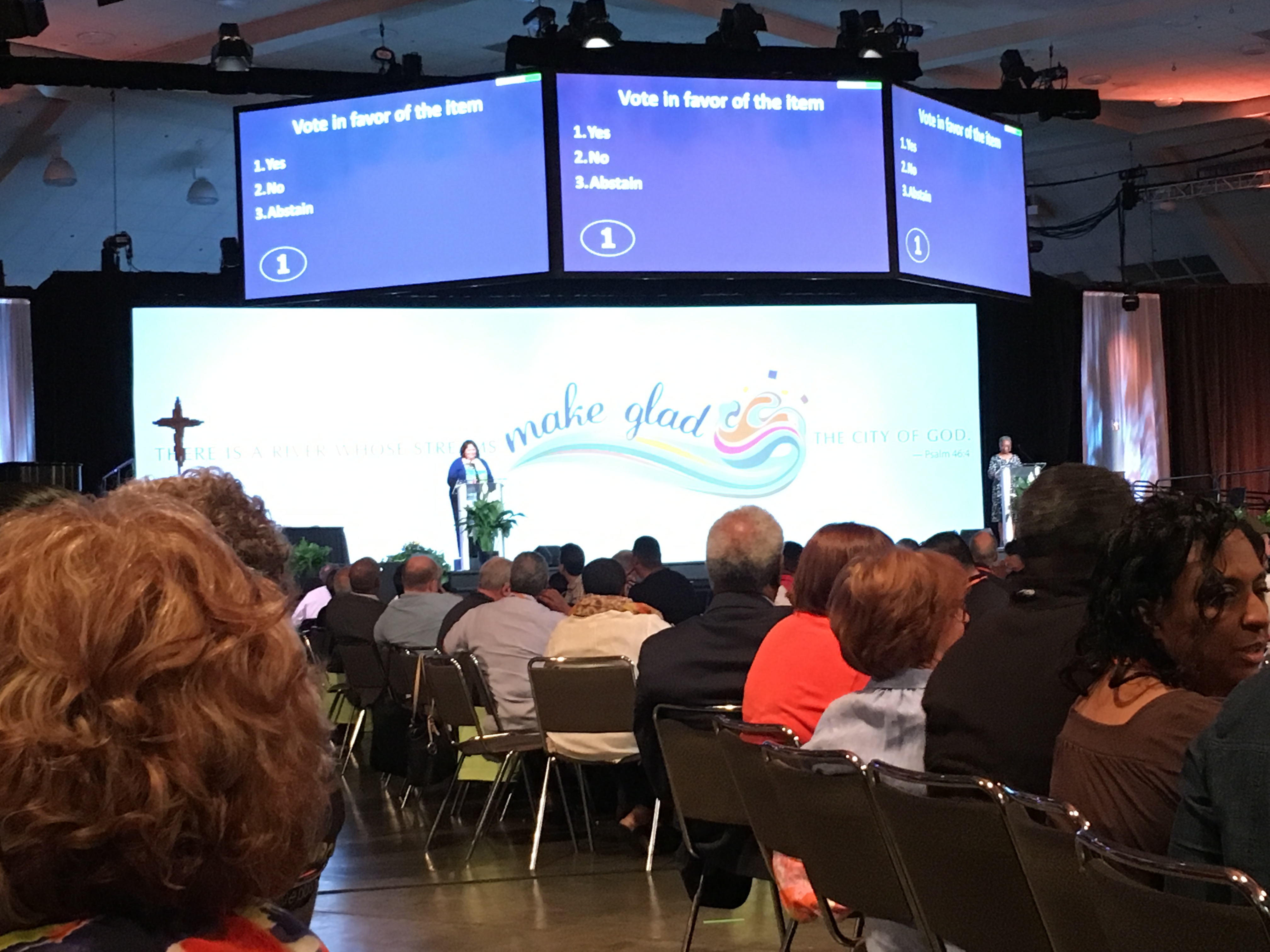
After finishing Friday’s post, early in the evening, I attended the meeting of the committee to which I was assigned—Resolution of Witness in Support of Legislation Authorizing Aid in Dying. I can’t say that I went into that meeting with strong feelings about the issue, but most of the concerns that might have prevented me from voting in favor were resolved during the hearing earlier in the day, when the details—including the very narrowly constructed circumstances through which such aid in dying could be accessed—were outlined. The committee meeting was mostly a very thoughtful discussion about the issue, including a couple of personal stories that were shared.

For the most part, I felt quite positive about the whole experience. People spoke respectfully and they listened as well. There was a moment, though, when someone stood up to talk about the “hard time” she was having with the issue and I was struck by the thought that we could have a resolution declaring that the sky is blue and there would be at least one person who felt compelled not simply to have a “hard time” with it, but also feel compelled to share their “hard time,” using of course, the maximum amount of time available. Still, except for that one strange expression of someone having a “hard time” (yet was unable to actually articulate anything that sounded at all truly connected to the issues at hand), it was a positive and rewarding experience, as a room full of strangers connected only by the tenuous thread of our nonhierarchical denomination, managed to conduct business with quite a lot of respect, humility and trust.  The resolution will now move on to the full assembly, probably Monday.

To sum up Saturday, I first should admit that I kept my Synod experience just to the morning. It was a very full morning, including a Maine delegation caucus meeting at 7:00 and the first plenary of the day starting at 8:00. The plenary ran until close to noon. That was enough Synod for me.

The first part of the morning was great. The Rev. Traci Blackmon, the candidate for the Justice and Witness Ministries Executive Minister, was introduced by a dynamic speaker. Then, Rev. Blackmon offered her candidate speech. While I didn’t agree with everything she said, I was impressed. She offered a meaningful, substantive speech, delivered clearly and passionately.   I was ready to take on the challenge of doing the “messy, difficult work” of “making room” and not just “creating space,” and considering carefully and thoughtfully the different set of tools we need to confront the things that divide us, understanding that healing comes in community.

When she finished, and we all stood up to applaud, it was only mid-morning—and it was looking like a very good day.

Alas, that’s when the day took a bad turn.

It was time for the keynote address of the morning, in the form of a conversation between the Synod Moderator and Ms. Glennon Doyle. I had never heard of Ms. Doyle, but the bio in the Synod materials described her as the “New York Times bestselling author of Love Warrior, which was chosen as one of Oprah’s Book Club picks for 2016, as well as the inspiring and hilarious New York Times bestseller, Carry On, Warrior. Doyle is the founder of Momastery, an on-line community where millions of readers meet each week to experience her shameless and laugh-out-loud funny essays about faith, freedom, addiction, recovery, motherhood and serving the marginalized.”

Ms. Doyle’s remarks began with a rundown of all of her life issues—addiction, bulimia, escaping pain, an unexpected pregnancy, a cheating husband, a divorce, etc. She went on to talk about life as “brutal,” but that most everything could be made better if only there was more yoga: “If you can sit with the hot loneliness, that is the journey of the warrior.”

Warrior?  Really?

She also had the enormously annoying habit, after making certain points, to say to the assembled, “Right?” just so that she could gather up a little affirmation from the audience, which seemed much too willing to offer it.

Ms. Doyle suggested that “we are all afraid of the pain,” but that we shouldn’t be, and that pain is the way to transformation— (say this next part in your best Valley Girl voice) because, you know, that’s what happened to Jesus, like he suffered and he could have escaped the pain, but he didn’t, and then he was crucified and then he experienced new life. Right?

Her remarks were delivered in that way that one hears occasionally from people who somehow, mysteriously and on shaky grounds (which Ms. Doyle was at least gracious enough to observe for herself), make it into the public square of purveyors of truth and wisdom. They think they are offering something tremendously original and profound, yet it’s really just pedestrian drivel.

And, what seemed even more problematic to me was, after not only such a great and inspirational morning, but a morning when we were challenged to consider the ways of injustice in our society and in our world, we were confronted by a clueless privileged white girl who appeared to argue that yoga is the answer to problems. And, much, much worse than that, that she touted a message of transformation through suffering and pain after a powerful and meaningful speech by an African American woman whose own family and ancestors likely heard the very same message—that through their suffering, they would—eventually—experience reward. Although Ms. Doyle made reference to Rev. Blackmon as a remarkable person, she seemed to have no actual appreciation for the content or context of the speech that Rev. Blackmon had given. The confrontation against what vexes as a society should have started in the midst of Ms. Doyle’s presentation.

Before it was over, I walked out. Eventually, though, I came back and listened to the rest of the morning’s speakers.

But, then I was done. And, off to the Walker Art Museum I went. And, after that, it was dinner with a few of my new Maine delegation Synod buddies, where we enjoyed the Inner Harbor of Baltimore.

Today’s start is a little later than yesterday. Thank goodness. But, then, there’s lots to do, with community worship this afternoon and a very full plenary session that begins just after dinner.


Posted in Uncategorized | Leave a comment

United Church of Christ General Synod 2017– Day One

It’s Day One of the United Church of Christ General Synod, gathering in Baltimore, MD. A long, string of words pop into my head as I think about this day. Most of those words have something to do with the array of people assembled in this enormous convention center.

Coming from Maine, I’m fully aware of how homogeneous my context is. At Synod, I expected a very different experience. And, that has certainly been true.

People of all shapes, sizes and colors are here. There’s also an interesting array of hair on display—some very colorful or arranged in an interesting presentation. And, as well, there’s a fascinating parade of mobility (something I didn’t really think about in advance)—with quite a few people on scooters and others with various aids in getting around, along with quite a few who walk with such purpose that it looks like anyone in their way may be in danger, and then a good number of people whose gait can best be described as strolling.

While the beginning of the day was filled with (not very exciting) meetings, the real interesting stuff started mid-afternoon, when we gathered for worship. Again, I knew I was in for a remarkably different experience from what I’m used to. And, it was.

I’m used to worship with 25-50 people, with the occasional holy day worship of around 100, along with a smattering of funerals where hundreds are in attendance.

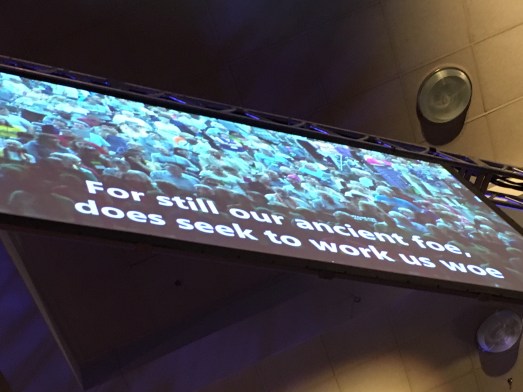
Synod worship was worship of a couple of thousand people, with huge screens throughout the large convention hall. And, that’s not all. The order of worship was not found on printed paper materials. Instead, it was available online or on the Synod “app.”

While it was a truly wonderful experience to be in that space, at worship, with people from all over the United States, I’ll also admit that there was something about it that I found not so fulfilling. In the huge crowd in attendance, worship possessed an element of anonymity. It really didn’t matter if I spoke the lines for the congregation. It really didn’t matter if I sang with the group.  It was certainly a great experience to be in such a large room, with thousands of people singing, worshiping and praising. But, it was also impersonal.

Day One is not quite done. I still have a committee meeting to attend this evening.

So far, it’s a mixed experience. On the one hand, it’s an incredible experience to be in a room full of such a remarkable diversity of humanity, of God’s creation. But, it’s not where I would want to be on a regular basis. Sure, big and diverse is great. But, small and intimate is also great.

Posted in Misc | Leave a comment

The Strong, But Dangerous, Allure of Denial

At Old South, I’ve started talking to the leadership team about beginning to discuss the process (just the process and not yet the content) of considering the future of Old South. How should we talk about, consider, make decisions about our future? Should we sell one of our two buildings, and if we think we should, how do we go about figuring out which one? Should we insert a “sunset clause” into our bylaws and, if so, what should it say? How shall we talk about our endowment, and how it should be used as we get smaller and have more trouble meeting our budget?

The simple act of talking about the process through which we might discuss these issues is raising a bit of anxiety—no surprise there. But, in the expression of anxiety a few interesting issues and perspectives have been exposed.

One of those issues is the concern over how it will “look” if we begin to talk openly about our decline. What if word gets out that we are thinking about selling one of our buildings? How will the larger community perceive the church if we begin such a process? How will we be judged? Will people consider joining us if we have what amounts to a “going out of business” sign out front?

Another issue is the possibility that even those among the most faithful of church members may decide to flee. Instead of engaging in the process of discerning the best path forward, the way that God is calling us to follow, some may prefer not only to stay out of that discussion—fraught as it is with complexity and emotion—but to leave the church altogether.

Some moments have transpired where the grasping onto denial is almost palpable, as if its soft comfort of security can be held like a child’s cherished blanket.

The aspect of all of this that seems to create a lot of discomfort is the notion that we must contend with a world that is not only changing, but has changed— past tense. Without a radical reorientation of our notions of what it means to be church, Old South’s days are numbered. And, even if we were to engage in a radical reorientation, our days may still be numbered. The world in which we exist is dramatically different. It’s not that things are changing. It’s that things have changed.

For me, it seems clear that we must heed the call to continue to live out our faithfulness as a church of Jesus Christ—no matter what happens. And part of that is to find the courage to keep the allure of denial at bay.

Sure, it is understandably tempting to bury our heads in the sand—to continue to do what we do and think that our fortunes will change at any moment, that we just need to be ready for some sort of reinvention of the 1950s. It’s also understandable to cast blame at all of the usual suspects—sports practices on Sunday mornings, the pastor who isn’t doing her job adequately, etc.

But, this is the time when we must demonstrate that we are a church, and not just a religiously affiliated business, that we are tied inexorably with our Savior, even to the point of being willing to die.

The challenge ahead of us is profoundly significant. We need to resist the temptation of denial. We also need to try to keep people from wanting to flee. We need to find the grace and the courage—as individuals and as a community— to speak up about our grief, sadness and even anger. We must be willing to talk about our emotional responses to what has happened, and to be willing to listen to each other.

Denial may feel a whole lot more comfortable—not to mention desirable. But, denial will keep us from perhaps a most remarkable experience—that though we die, we may also live. In walking the path to our end, we may find a whole new beginning. It’s just that to walk this path is to give up control of our church, and to trust that it is Christ’s. We need to be willing to give up what we hold dear, and to trust that our Savior will be there to catch us as we fall.

The road ahead is not an easy one, but it is one that may very well offer something much more wonderful, a security that no blanket can bestow.

Posted in Doomed | Tagged | Leave a comment

The Great Commission in the Old Mainline

This past Sunday, the first Sunday after Pentecost aka “Trinity Sunday,” we at Old South focused on the lectionary passage from Matthew—The Great Commission, “go therefore and make disciples of all nations” and “I’ll be with you until the end of the age,” etc.

In my prep work for Sunday, I stumbled across a Day 1 sermon, in which the preacher offered the following observation regarding the making of disciples and the decline of the Mainline: “As the church has turned inward over the last 30 or 40 years, it has lost sight of its mission to make disciples. This is one of the reasons why the mainline church is struggling to grow. The stats don’t look good. The mainline church overall is not replenishing itself with a new generation of disciples.”

It is certainly true that many Mainline churches, like Old South, have experienced a serious decline in the last decades, with members leaving or dying and not much in the way of newer members coming in. This trend, though, is complicated.

There was something about the observation at the beginning of that preacher’s sermon that stuck in my head, and stayed there for a while. I couldn’t, initially, figure out why. I wondered about it for days.

Finally, some clarity formed and the threads that I knew were there, separate and distinct, came together into a (mostly) coherent series of questions: what does it mean to “make disciples”? Were all, or even most, of those people who swarmed into the Mainline back in the fifties and sixties “disciples”? Is there a difference between “disciple” and “church-goer”?

Over the years, I’ve talked to a lot of people about their church experiences, most of those people still part of the church, but quite a few who are not part of any church any longer. When I look back and consider those conversations, especially as people have reflected on their experiences half a century ago, I am often left with the impression that a lot of church involvement of the mid-20th century might not have been what Christ was getting at when he offered his “great commission.” Church attendance in the Mainline during those middle century years sounds similar to other civic involvement, as the mid-20th century cultural ethos, forged in response to two world wars, encouraged a lot of participation in community. And, church was one of those places. Sure, the church provided good values and even a spiritual dimension to human life, but the Mainline was not especially good at doing more than “making church-goers” who, dare I suggest, were not necessarily “disciples.”

The more I think about it, the more I feel that there is a difference between the two, that there were, and still are, some “church-goers” who aren’t quite “disciples,” nor do they wish to be. Church going is, relatively anyway, easy. It’s a nice routine and habit; it lends itself to something different in the average week—a place to be in community, to sing or just to listen, to feel a sense of purpose, and to reconnect with something beyond oneself. Church-going is not really a hard thing.

Discipleship is different. It is harder road, a more demanding one. Discipleship asks tough questions about who one is, one’s relationship with God, and one’s connection to the world. Discipleship offers an invitation to the “narrow way,” while at the same time, expecting an openness to love, grace, hope and blessing that stretches the outer limits of our own neat sense of order.

When I hear those words, to “make disciples,” I think of my small community of Old South, where we challenge ourselves and encourage each other to be disciples, and to share the love of God with others. It may be that we will get smaller in number, but at the same time, we have the opportunity to grow in Spirit, to learn and accept that our faithfulness to the Gospel is not measured by how many butts sit in the pews of the sanctuary, but in our willingness to follow, even into unfamiliar territory of love, hope and peace—and to do so over and over again.

The wording of the Great Commission, in the original Greek, suggests that “making disciples” is really “teaching disciples.” We serve and plant seeds, and trust that they will take root and grow, perhaps not exactly where we would like, but in accordance with the presence of Christ. Our life in the church, as followers of Christ, ought to be more about quality than quantity.

Posted in Misc | Tagged , , , | Leave a comment

What Is Church For? Part 2

During a recent “faith story” (children’s message) during worship, I talked about the significance of various people in our church and in our worship life at Old South. We began with the “here is the church, here is the steeple” rhyme, ending with, “you can have a church without a steeple, but you can’t have a church without any people.” And, then I went on to ask what would happen if certain people decided not to show up for Sunday worship. What if the music director didn’t show up for worship, or the choir, or the greeters, or the Sunday School teachers, etc.? And, then I asked, “What would happen if I didn’t show up?”

And, without missing a beat, someone in the choir chimed in, “We could all go home!”

And the people laughed.

I know it was meant to be funny, and it was, but at the same time, it was a moment that betrayed a raw and difficult reality—that even among those who attend Old South, and churches like it, a certain level of ambivalence lurks in our midst. I don’t doubt that many who attend Old South feel a sense of deep connection to the life of the church, but I sometimes worry about the threads of that connection. I know we have some people who wouldn’t be at Old South but for the choir. Friendships and relationships are important, too. And, there are a number of people who share with me the need to spend some time each week in a place set apart, when they can be renewed in their connection to God, etc. There are others for whom worship is a part of their weekly routine.

Still, a tension rears its ugly head from time to time that for at least a few of Old South’s most active participants, my role as “pastor and teacher” is not quite on the list of church priorities—especially when it comes to my post in the pulpit.

Last week, as we were preparing for this past Sunday’s worship, celebrating Pentecost and Music Sunday, with communion as well, we started to fret a bit about the length of the service. After the weekly choir rehearsal, I got a call from the church secretary (who is also in the choir), asking a question posed by another choir member: would I consider eliminating the “sermon” from the service? You know, to save a bit of time. I heaved a heavy sigh.

In these days of concern over the future of our church, as we watch our average weekly attendance decline and our average age increase, it seems that the church could use a little more in the way of what my job is, that is “pastoring and teaching.” Our holy book, after all, offers many significant lessons and perspectives pertinent to the challenges we face. Yet, there is resistance.

Resistance, I should be clear, is not a dominant force in the life of Old South. Yet, it is present in ways that ought not be ignored—because it gets in the way. It hinders new things and new ideas. It obscures the movement of the Spirit. It undermines our relationship with the Gospel.

It’s not a bad thing to experience a funny moment in the midst of worship, or to observe, occasionally, the age-old disdainful attitude toward sermons (although, I can’t help but get a little disdainful back—I mean, really, my sermons are rarely over fifteen minutes these days). But, when it starts to become more than a sporadic quip, one must ask critical questions about the overall wellbeing of the church, as a community of God’s people, devoted to the living out of the Gospel. If our attachment to our scriptures—and our desire to learn more about how those scriptures still speak to us—is not held in high esteem, as a central piece of who are and what we do, we must then ask about the point of our gathering.

While there are many aspects of our life together that contribute to keeping us attached, we must never lose sight of the fact that we gather as “church,” as a holy people, a “spiritual house,” grounded in faith and in the Gospel. That must be, and must remain, at the core of our being. Or, we are really just a club and not a church.

Posted in My Life as Pastor | Tagged , , , , | Leave a comment

Old and New, and the Problem of Judgment

I recently attended a lecture given by Diana Butler Bass. In her remarks, she talked about the “old” way of doing church—living out and expressing the Christian faith (which is the way that the Church has been Church for a very long time)—and the “new” way of living out and expressing the Christian faith. The “old” way she described as the elevator approach to faith and to God, with the church acting as a sort of vertical mediator. One enters the elevator and is either lifted into God’s presence, distant from the miasma of earth, or is sent below, to what some call hell and others don’t want to talk about, but it’s there, in the opposite direction from God who is “up there” in the heavens.

The new way of expressing and living out the faith, she described as a more horizontal approach. It’s a way of understanding the Divine that speaks to people like her college age daughter. God is out and about, here on earth and into the universe, moving in and through creation. God is not simply “up there,” far away from Creation, creating a vertical axis upon which our spiritual lives rotate. Instead, there is a more horizontal approach of the God we worship, no longer distant, but instead much more present.

This is not necessarily an unhelpful shift in how we Christians perceive and engage with our faith. But, there is a significant issue—and problem— that lurks in the raising up of these shifts from one generation to another, especially now as the shift is really a very large, seismic shift from one way of understanding to a very different way of understanding faith.

The problem lies in one word: judgment. More specifically, there is a problem when the “new” way is cast as the “better” way, and even more problematic when the new way is considered the “right” way, and the old way “wrong.”

It’s not a good, nor noble or appropriate, dimension or habit of faith to consider one way correct and more in line with what God wishes, and other ways as misguided, or wrong, or worse still, essentially the worship or work of evil.

Of course, when it comes to religion, faith and other ways through which we organize ourselves, human existence is rife with claims of who is doing things the right way and others doing things the wrong way. As someone living in the midst of this new, dramatic shift, my hope is that we can tone down the judgmental language, and can allow a little more language that acknowledges our differences in a more neutral way.

It’s not that one way is the right way and any other way wrong. When it comes to figuring out how to worship God, we ought to have a better appreciation for the fact that we will never get it perfectly right. Perfection is God’s business, not ours.

When it comes to the shifts that are now becoming increasingly clear in Christianity, I think it’s especially important to consider language and tone very carefully. Old South, the church that I serve, is full of people who tend to have a more vertical approach to the faith, although they have more of an appreciation for the horizontal than I think Diana Butler Bass would recognize. But, more than that, many of them are truly genuine in their faith and in their desire to follow the way of Christ. They like to gather on Sunday mornings, in a sanctuary, with a traditional order of worship, and sing hymns, etc. That doesn’t mean that they are “doing it wrong,” or even looking for God in the wrong places.

They are living out their faith. Younger people may indeed have a very different way of gathering as a faith community and worshipping. But, just because it is newer, or done by younger people, doesn’t make it the “right” way. It is a new way, and it speaks meaningfully to those who participate—just as the traditional worship speaks meaningfully to my congregation.

Whether we tend to the vertical or the horizontal, we are people seeking to reach out to God, as God reaches out to us. To adopt the notion that one way is the right way, and other ways are wrong ways, is to undermine the faith we seek to practice. In these days, when we already have plenty of people who think that their way is the one and only right way, we could use good, strong leadership that takes a more neutral approach to new ways of seeking meaning and engaging with the God of love. New ways have much to teach the old ways, and old ways have much to teach the new. Let us alter the tone: no judgment.

Posted in Misc | Tagged , | Leave a comment

A Mothers Day Approach to God

When I was a child, I spoke like a child, I thought like a child, I reasoned like a child; when I became an adult, I put an end to childish ways. For now we see in a mirror, dimly, but then we will see face to face. Now I know only in part; then I will know fully, even as I have been fully known.
1 Corinthians 13: 11-12

For preschool and early elementary school, both of my children attended the local Montessori school, a wonderful place of curiosity, learning and exploration. One of the highlights of the year was the annual Mothers Day Tea. The children, dressed up in their best outfits, served their mothers tea and breakfast breads, while the smiling mothers perched precariously upon kid-sized chairs.

During the tea, each mother received a lovely gift made by her child and a card. The card, decorated by the child, contained a piece of paper with easily readable, computer-generated text that offered information about the mother that the teacher had gleaned from a recent interview.

The cards were almost always hilarious. They commonly included a physical description of the woman in question, which often did not line up well with reality. There usually was a comment or two about where the mother worked, or what she liked to do in her spare time, etc. These descriptive pieces, almost without question, had something to do with what had happened at home the day before the interview. The memory of small children just doesn’t go back all that far. But, still, the sense remained of something long-standing, if not permanent.

Like the time that my son’s card stated, “She likes to watch TV all day, that’s her favorite thing to do.” About a week before that particular Mothers Day, and conveniently just about at the time of the annual Mothers Day card interview, I had thrown my back out and had spent a couple of days lying on the coach in our living room, watching a lot of television. I was miserable. My son, though, had processed my predicament in a very different way. While he welcomed the idea of watching TV all day, I can honestly say that about halfway through my first day, I knew for sure that watching TV was not my “favorite thing to do.”

For John, it was what was most recently on his mind, reflected through his own wishes and dreams, and then cast as normative for my life, the life of his mother.

I sometimes wonder if this is something along the lines of how good church people deal with their relationship with God.

In my experience as pastor, the memories of good church people include a string of memory that somehow keeps God trapped in notions formed in childhood. The sense of God is also heavily influenced by one’s own needs and desires. Complicating the whole thing is often a troublesome lack of self-awareness of that prism through which God is perceived.

Even for long-time church-goers, the question remains: to what extent do we understand and approach God as child, rather than adult? I realize that it doesn’t help that we use a lot of “father” language to talk to and about God. Sure, Jesus spoke to and prayed to God using parental language, with the use of the word “Abba.” But, it’s not clear that Jesus used that word to define God as ultimate “Father.” Instead, “Abba”/Daddy may have been used to convey an intimate and close relationship.

On a number of occasions lately, at Old South and in other venues where I encounter people of faith, I’ve noticed a sort of desire for a certain kind of God—one that is quite like an ultimate parental figure, ready to love unconditionally but also sometimes the seemingly watchful punisher when we go astray. I suppose that when the world feels especially uncertain, it’s a comfort to seek God as caring parent, as protector and guardian, who will sort things out and make things right.

It seems to me that we are called to enter into a more complex understanding and relationship with God as we grow into the faith, over our entire lives. To perceive God in our adulthood is to appreciate that there are things that we can know about God, while there are other aspects of God that remain a mystery to us. To be among God’s people is to allow a significant level of self-awareness that God is not solely our Parent, whose only “job” is to protect and love us, and help us against our “enemies” (as we define “enemy”). We may have a picture in our head about who and what God is, but we ought also understand deeply that that picture is a limited one.

In order to, one day, be able to see fully, as we ourselves are fully known, we are invited to acknowledge the dimness of our ability to see and understand. But, still, we are on a path that offers an opportunity to grow in mind and spirit, as our bodies have grown from child to adult. For our faith to sustain us—and for our faith to be worth passing along—we must accept the grace and blessing of God which helps us recognize the beauty and assurance, as well as the wonder and mystery of faith.

Posted in My Life as Pastor | Tagged , , | Leave a comment

What Is Church For?

It’s been an interesting week in the office of Old South, with two particular occasions that got me thinking, once again, about the church and its purpose in these days.

The first occasion involved a visitor, whose presence was announced when he tapped on the window of my office. I nearly had a medical episode, as no one has ever tapped on my window in the many years I’ve served Old South. The window of my office, which is in the basement, isn’t easy to get to, so it was a bit of a shock when this man went to the trouble to get to the window so he could tap on it to get my attention. After the initial shock, he yelled through the window, “How do I get in?” My answer, “The door.” When he returned a puzzled look, I indicated the doors on either side of the building.

I then went upstairs to meet him, a little wary of a man who had an easier time finding my window than the front door. Our conversation was brief, but pointed. He said (in a rather aggressive way) that he was looking for a Christian Church, emphasis on “Christian.” I indicated that Old South is a Christian Church. He then went on to ask about certain items of doctrine and dogma, to which I tried to gently explain that Old South doesn’t require adherence to much of any items of doctrine or dogma, that the people of Old South may make their own choices about what they believe. When he asked about whether or not the Old South “believes” in the “Rapture,” I hesitated. That was enough for him. He turned on his heels and left, muttering something about the church not actually being “Christian.”

The other interesting experience of the week involved a phone call, from another man who said that he was looking for a church to attend. He is new to the area and had attended worship at another local United Church of Christ church. The minister that day had a petition for people to sign, regarding something around immigration. The man didn’t like it—that “politics” should stay out of church, that Sunday mornings should offer a break from what we have to deal with during the week in the news, etc.

These two individuals, as well as lots of other visitors to whom I’ve spoken over the years, have relatively clear ideas of “church,” and what church should be and what they are looking for in a church to attend.

For the most part, this is completely understandable. It’s also likely at least part of almost every church-goer, as people are free to attend, or not attend, the church of their own choosing.

But, here’s the thing: What is church for? Is it to support one’s predetermined notions of God and Christianity, of “church”? Is church all about finding a place where there is common agreement regarding doctrine and dogma, the “rules” of life and faith? Is church a place to escape from the “world,” a place only of sanctuary from the difficult, complicated world in which we live? Is the purpose of church primarily to cater to one’s needs and desires?

It’s one thing to go looking for a church in which one feels comfortable and connected, where one feels that one’s faith will be supported, renewed and refreshed, but is the role of the church only to reflect one’s own preconceived notions of the gathered community of the faithful?

The New Testament is full of examples and incidents where long-held ideas, values, notions of who God is and what God requires, are tested, pushed, and sometimes completely leveled as wrong. How should that work in today’s church?

If all the church is “for” is to uphold what one already knows to be true, then I wonder if this whole venture is already lost. What is the role of the church in challenging our notions, in opening up the possibility of change and transformation? If we already know what we believe, and know it to be “true,” why bother with church at all, if all it becomes is a weekly pat on the back?

Should the church conform to us, or should we Christians be more attuned to what it means to follow the way of our Savior, and to be shaped and molded by the journey of faith?

To worship and believe is to recognize that one is not God, and therefore one’s awareness, one’s understanding, one’s beliefs are always limited, and always possibly wrong or even misguided. The church ought to be that place where we gather to support and encourage each other for the journey, but also where we dare to open our hearts and our minds to the ongoing presence of the holy—mysteriously but wondrously both comforting and challenging.

Posted in Misc, My Life as Pastor | Tagged , , , , , | Leave a comment

Church, Women and a Young Evangelist

My seventeen-year-old son, mostly a reluctant church-goer, is very good friends with a teenage boy who is not a reluctant church goer, but instead an eager one. This friend attends a local Southern Baptist church (though it is not at all obvious that that’s what it is, as they call themselves a “community church”), which also happens to be one of the very rare growing churches in the area.

My son attended worship with this friend one Sunday last summer, and came home perplexed by the whole experience. “They don’t pray the Lord’s Prayer,” was one of the first observations my son shared. He also noticed that the worship featured a lot of rock-style music (that he described as “cheesy”), along with a very long sermon by the preacher, and then more rock music. And, not much else. My son found it odd that there was not much for the congregation to do, other than listen and nod their heads. My son went on to critique the sermon, which seemed to be all about how the preacher was led, by God, to buy a certain minivan and that God helped him get a great deal.

As he told me the story, my son couldn’t help but shake his head in bewilderment. In our household, and in my ministry, I’m not much of a “particular providence” sort of person. I was gratified that my son had absorbed that message, as he was disconcerted by the pastor’s notion that God would get so directly involved in the buying of a minivan, yet seem not to care about things like mass shootings and famine.

It turns out that my son has been absorbing a few other things as well. Since November’s presidential election, I’ve not only written about, but have also preached on sexism—the sexism that I perceive as a significant component of the result of the election, and the Christian Church’s role in preaching and supporting (obviously, and less obviously) the subordination of women. And, I’ve made it clear that I’m concerned not just about men in this situation, but also women, who so often seem to go along with second class status, even when they claim not to like it.

My son has been paying attention.

Part of my Easter sermon this year highlighted the profound significance of the role of women in the Easter story and at the very beginning of the Christian story, as reported by Matthew, and the evangelism of Mary Magdalene in particular. I observed that even in the 21st century, most Christians attending worship on Easter went to churches and denominations that prohibit the preaching of women—from Roman Catholics to Orthodox to Southern Baptists, the largest Protestant denomination in the U.S. In the days after Easter, my son contacted his friend and asked him a simple question, “Doesn’t it bother you that your church doesn’t allow women to preach?”

I hadn’t asked him to contact his friend, or ask the question. It wasn’t even until at least a day later than he told me that he had asked the question at all. And, also added that he offered his own answer to the question, “Doesn’t it bother you that your church doesn’t allow women to preach?” And, that answer was, “It should.”

Who knew that my son had been listening for so long and not only absorbing information, but willing to say something, to point to the ugly tendency for some—many —Christian churches to deny women a significant role in preaching and teaching the good news, even though if it hadn’t been for women, we might not have Christianity at all—as the men had locked themselves away on that first Easter.

When I ask women who attend these sorts of churches if it bothers them that women are excluded from the pulpit, just because of their gender, I almost always get a response something along the lines, “Well . . . I don’t like it, but . . . the church is doing so many good things, I guess I’m willing to live with it.”

I’m glad to know that, even though lots of women are willing to put up with second class status (not actually well supported by scripture, by the way), my son has felt the call to speak up. As the parent of both a male and a female, I often encourage and support the feminism of my daughter. I’ve learned a valuable lesson: I shouldn’t expect less from my son.

So far, John hasn’t made any headway in changing his friend’s mind (they have met in person to talk, as well as keeping up a texting dialogue). But, I trust that he will continue to explore the role of women in his life and perhaps will be the sort of person who will not put up with what so many women seem willing to accept. After all, Mary Magdalene was not simply an evangelist for women, but for all Christians—willing to see, willing to appreciate, willing to believe the unbelievable, and willing to speak, willing to share the good news for all.

Posted in Holy-Days, Misc | Tagged , , | 1 Comment

Thank You, Ross Douthat

Now, there’s a string of words that I never thought I would type, let alone choose as a title for a blog post. But, in an Easter surprise, I find myself in complete agreement with Mr. Douthat, conservative columnist for the New York Times.

If you didn’t see it, Mr. Douthat wrote a column (as he does most Sundays) on Easter Sunday entitled, “Save the Mainline.” [https://www.nytimes.com/2017/04/15/opinion/sunday/save-the-mainline.html  In the column, Douthat—not only a conservative but also a Roman Catholic—argued, “For the sake of their country, their culture and their very selves, liberal post-Protestants should find a mainline congregation and starting attending every week.”

I couldn’t agree more!

Douthat’s column goes on to say, “The wider experience of American politics suggests that as liberalism de-churches it struggles to find a nontransactional organizing principle, a persuasive language of the common good.” Or, as I might put it, liberalism begins to lose its sense of common humanity. Away from church, liberalism, in its seemingly unquestioned claim to be “inclusive,” actually displays the tendency to build a wall around its “inclusivity,” denying the basic and essential humanity of those with whom it disagrees.

I experienced one tiny example of this sort of trend last week, during a tour of colleges with my son, who is a high school junior. At most of the colleges we visited I asked, of an admissions counselor or tour guide, about free speech on campus, and whether or not the college we were visiting had engaged in any organized discussion of what recently took place at Middlebury College, where a talk by Charles Murray (a conservative fellow at the American Enterprise Institute) was shut down by violent student protestors.

In response to my question, I got an array of answers, with at least a couple of college representatives having no idea what I was talking about. At one college, though, the tour guide was indeed knowledgeable about the incident and reported that on that particular campus vigorous conversation had taken place. He assured me that the college of which he is part is truly committed to free speech, and a diversity of views and perspectives. As an example, he pointed to an upcoming presentation from one of the founders of “Black Lives Matter.” While such a presentation certainly seemed worthwhile to me, I went on to say that it seemed unlikely that there would be any sort of organized protest for such an event on that campus. But, what if a conservative speaker, like Charles Murray, were to be invited? What might happen? The student looked at me in complete and utter bafflement, his face displaying a sort of shocked lack of understanding, as if to say, “Why would we do that?”

This little incident is just one tiny example, I realize, but I experienced similar exchanges on the various college campuses we toured, mostly northeastern liberal arts colleges. For almost every campus we visited, the decline of liberal Protestantism is on full display, with at best, limited understanding of what a “liberal Protestant” even is. More often, the simple raising of the subject of Christianity in general is to conjure images of closed-minded enemies to the mission of a good liberal education.

The young people I met voiced their commitment to “inclusion” and “community,” with great and impassioned enthusiasm. Yet, it was clear that “inclusion” was limited, and anything outside of their particular view (and those of their professors) was not simply a different, if wayward, view. It was to be actively protested, shut down, and denied. Common humanity, it turns out, has its limits.

Religion, while certainly not without its own issues and problems, often offers just the antidote to the idea that “inclusion” is only “inclusive” so long as the parties within agree with each other. Protestant Christianity, in particular, preaches many of the very same goals of those liberals and progressives in places like college campuses. But, it also offers a critical and vital difference: the recognition of our common humanity, even for those whose views and solutions to the ills of society are different.

The simple notion, grounded in the Hebrew Scriptures, and highlighted by Jesus, known as the Golden Rule (do unto others as you would have them do to you), is actually very important to our ability to share this planet, as well as our communities. Somehow, liberalism without religion has lost this ethical anchor.

Good old Mainline Protestantism offers a relatively easy path back to some of what liberalism needs. But, it isn’t going to be available much longer, if people continue to stay away.

As Douthat notes, entry into the Mainline shouldn’t be too difficult: “You say you’re spiritual but not religious because you associate ‘religion’ with hierarchies and dogmas and strict rules about sex. But the Protestant mainline has gone well out of its way to accommodate you on all these points.”

Very true.

In the small, aging church I serve, we seek to be welcoming, inclusive and accommodating—we even have a couple of people who really don’t consider themselves Christian at all. At Old South, we seek to be a community of faith, supporting and encouraging each other in this journey of life. We (most of us anyway) identify as Christian, and seek to follow the teachings of Jesus, yet we also—though I know this might sound shocking—struggle with certain theological concepts like resurrection. We do our best to welcome strangers and to share the love of God that we experience. And, we also try very hard to live out the Golden Rule. This isn’t always easy. Old South is a community of different kinds of people, including people with differing political views. Without our faith at the core, it would be relatively easy for one to dismiss another, when disagreements arise. But, that doesn’t happen. While it can be a challenge, we recognize the significance of our common humanity.

We do something, often without ever even thinking about it, that those students at Middlebury College were not willing to do—we listen to each other; we recognize that not one of us is perfect nor has the perfect solution to a problem. We do unto others as we would have them do to us—even when we think they are wrong.

Mainline Protestant churches have a lot to offer, for individuals, families and communities—and for the country. But, we aren’t going to be around forever, just because we have something worthwhile. We need you. And, may I be so bold to suggest, that you need us as well.

Posted in Misc | Tagged , , , , | Leave a comment