The Great Commission in the Old Mainline

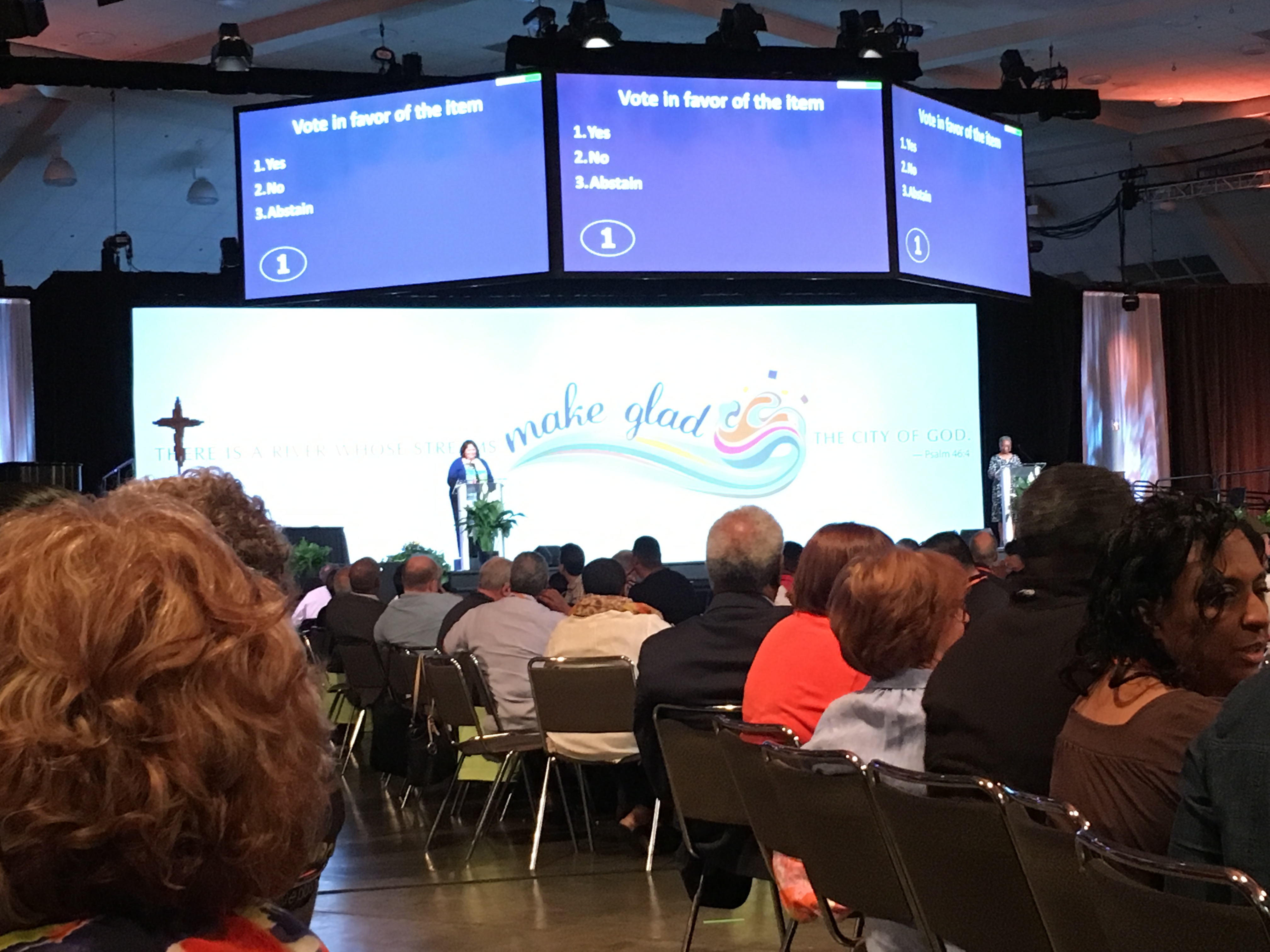
This past Sunday, the first Sunday after Pentecost aka “Trinity Sunday,” we at Old South focused on the lectionary passage from Matthew—The Great Commission, “go therefore and make disciples of all nations” and “I’ll be with you until the end of the age,” etc.

In my prep work for Sunday, I stumbled across a Day 1 sermon, in which the preacher offered the following observation regarding the making of disciples and the decline of the Mainline: “As the church has turned inward over the last 30 or 40 years, it has lost sight of its mission to make disciples. This is one of the reasons why the mainline church is struggling to grow. The stats don’t look good. The mainline church overall is not replenishing itself with a new generation of disciples.”

It is certainly true that many Mainline churches, like Old South, have experienced a serious decline in the last decades, with members leaving or dying and not much in the way of newer members coming in. This trend, though, is complicated.

There was something about the observation at the beginning of that preacher’s sermon that stuck in my head, and stayed there for a while. I couldn’t, initially, figure out why. I wondered about it for days.

Finally, some clarity formed and the threads that I knew were there, separate and distinct, came together into a (mostly) coherent series of questions: what does it mean to “make disciples”? Were all, or even most, of those people who swarmed into the Mainline back in the fifties and sixties “disciples”? Is there a difference between “disciple” and “church-goer”?

Over the years, I’ve talked to a lot of people about their church experiences, most of those people still part of the church, but quite a few who are not part of any church any longer. When I look back and consider those conversations, especially as people have reflected on their experiences half a century ago, I am often left with the impression that a lot of church involvement of the mid-20th century might not have been what Christ was getting at when he offered his “great commission.” Church attendance in the Mainline during those middle century years sounds similar to other civic involvement, as the mid-20th century cultural ethos, forged in response to two world wars, encouraged a lot of participation in community. And, church was one of those places. Sure, the church provided good values and even a spiritual dimension to human life, but the Mainline was not especially good at doing more than “making church-goers” who, dare I suggest, were not necessarily “disciples.”

The more I think about it, the more I feel that there is a difference between the two, that there were, and still are, some “church-goers” who aren’t quite “disciples,” nor do they wish to be. Church going is, relatively anyway, easy. It’s a nice routine and habit; it lends itself to something different in the average week—a place to be in community, to sing or just to listen, to feel a sense of purpose, and to reconnect with something beyond oneself. Church-going is not really a hard thing.

Discipleship is different. It is harder road, a more demanding one. Discipleship asks tough questions about who one is, one’s relationship with God, and one’s connection to the world. Discipleship offers an invitation to the “narrow way,” while at the same time, expecting an openness to love, grace, hope and blessing that stretches the outer limits of our own neat sense of order.

When I hear those words, to “make disciples,” I think of my small community of Old South, where we challenge ourselves and encourage each other to be disciples, and to share the love of God with others. It may be that we will get smaller in number, but at the same time, we have the opportunity to grow in Spirit, to learn and accept that our faithfulness to the Gospel is not measured by how many butts sit in the pews of the sanctuary, but in our willingness to follow, even into unfamiliar territory of love, hope and peace—and to do so over and over again.

The wording of the Great Commission, in the original Greek, suggests that “making disciples” is really “teaching disciples.” We serve and plant seeds, and trust that they will take root and grow, perhaps not exactly where we would like, but in accordance with the presence of Christ. Our life in the church, as followers of Christ, ought to be more about quality than quantity.

Posted in Misc | Tagged , , , | Leave a comment

What Is Church For? Part 2

During a recent “faith story” (children’s message) during worship, I talked about the significance of various people in our church and in our worship life at Old South. We began with the “here is the church, here is the steeple” rhyme, ending with, “you can have a church without a steeple, but you can’t have a church without any people.” And, then I went on to ask what would happen if certain people decided not to show up for Sunday worship. What if the music director didn’t show up for worship, or the choir, or the greeters, or the Sunday School teachers, etc.? And, then I asked, “What would happen if I didn’t show up?”

And, without missing a beat, someone in the choir chimed in, “We could all go home!”

And the people laughed.

I know it was meant to be funny, and it was, but at the same time, it was a moment that betrayed a raw and difficult reality—that even among those who attend Old South, and churches like it, a certain level of ambivalence lurks in our midst. I don’t doubt that many who attend Old South feel a sense of deep connection to the life of the church, but I sometimes worry about the threads of that connection. I know we have some people who wouldn’t be at Old South but for the choir. Friendships and relationships are important, too. And, there are a number of people who share with me the need to spend some time each week in a place set apart, when they can be renewed in their connection to God, etc. There are others for whom worship is a part of their weekly routine.

Still, a tension rears its ugly head from time to time that for at least a few of Old South’s most active participants, my role as “pastor and teacher” is not quite on the list of church priorities—especially when it comes to my post in the pulpit.

Last week, as we were preparing for this past Sunday’s worship, celebrating Pentecost and Music Sunday, with communion as well, we started to fret a bit about the length of the service. After the weekly choir rehearsal, I got a call from the church secretary (who is also in the choir), asking a question posed by another choir member: would I consider eliminating the “sermon” from the service? You know, to save a bit of time. I heaved a heavy sigh.

In these days of concern over the future of our church, as we watch our average weekly attendance decline and our average age increase, it seems that the church could use a little more in the way of what my job is, that is “pastoring and teaching.” Our holy book, after all, offers many significant lessons and perspectives pertinent to the challenges we face. Yet, there is resistance.

Resistance, I should be clear, is not a dominant force in the life of Old South. Yet, it is present in ways that ought not be ignored—because it gets in the way. It hinders new things and new ideas. It obscures the movement of the Spirit. It undermines our relationship with the Gospel.

It’s not a bad thing to experience a funny moment in the midst of worship, or to observe, occasionally, the age-old disdainful attitude toward sermons (although, I can’t help but get a little disdainful back—I mean, really, my sermons are rarely over fifteen minutes these days). But, when it starts to become more than a sporadic quip, one must ask critical questions about the overall wellbeing of the church, as a community of God’s people, devoted to the living out of the Gospel. If our attachment to our scriptures—and our desire to learn more about how those scriptures still speak to us—is not held in high esteem, as a central piece of who are and what we do, we must then ask about the point of our gathering.

While there are many aspects of our life together that contribute to keeping us attached, we must never lose sight of the fact that we gather as “church,” as a holy people, a “spiritual house,” grounded in faith and in the Gospel. That must be, and must remain, at the core of our being. Or, we are really just a club and not a church.

Posted in My Life as Pastor | Tagged , , , , | Leave a comment

Old and New, and the Problem of Judgment

I recently attended a lecture given by Diana Butler Bass. In her remarks, she talked about the “old” way of doing church—living out and expressing the Christian faith (which is the way that the Church has been Church for a very long time)—and the “new” way of living out and expressing the Christian faith. The “old” way she described as the elevator approach to faith and to God, with the church acting as a sort of vertical mediator. One enters the elevator and is either lifted into God’s presence, distant from the miasma of earth, or is sent below, to what some call hell and others don’t want to talk about, but it’s there, in the opposite direction from God who is “up there” in the heavens.

The new way of expressing and living out the faith, she described as a more horizontal approach. It’s a way of understanding the Divine that speaks to people like her college age daughter. God is out and about, here on earth and into the universe, moving in and through creation. God is not simply “up there,” far away from Creation, creating a vertical axis upon which our spiritual lives rotate. Instead, there is a more horizontal approach of the God we worship, no longer distant, but instead much more present.

This is not necessarily an unhelpful shift in how we Christians perceive and engage with our faith. But, there is a significant issue—and problem— that lurks in the raising up of these shifts from one generation to another, especially now as the shift is really a very large, seismic shift from one way of understanding to a very different way of understanding faith.

The problem lies in one word: judgment. More specifically, there is a problem when the “new” way is cast as the “better” way, and even more problematic when the new way is considered the “right” way, and the old way “wrong.”

It’s not a good, nor noble or appropriate, dimension or habit of faith to consider one way correct and more in line with what God wishes, and other ways as misguided, or wrong, or worse still, essentially the worship or work of evil.

Of course, when it comes to religion, faith and other ways through which we organize ourselves, human existence is rife with claims of who is doing things the right way and others doing things the wrong way. As someone living in the midst of this new, dramatic shift, my hope is that we can tone down the judgmental language, and can allow a little more language that acknowledges our differences in a more neutral way.

It’s not that one way is the right way and any other way wrong. When it comes to figuring out how to worship God, we ought to have a better appreciation for the fact that we will never get it perfectly right. Perfection is God’s business, not ours.

When it comes to the shifts that are now becoming increasingly clear in Christianity, I think it’s especially important to consider language and tone very carefully. Old South, the church that I serve, is full of people who tend to have a more vertical approach to the faith, although they have more of an appreciation for the horizontal than I think Diana Butler Bass would recognize. But, more than that, many of them are truly genuine in their faith and in their desire to follow the way of Christ. They like to gather on Sunday mornings, in a sanctuary, with a traditional order of worship, and sing hymns, etc. That doesn’t mean that they are “doing it wrong,” or even looking for God in the wrong places.

They are living out their faith. Younger people may indeed have a very different way of gathering as a faith community and worshipping. But, just because it is newer, or done by younger people, doesn’t make it the “right” way. It is a new way, and it speaks meaningfully to those who participate—just as the traditional worship speaks meaningfully to my congregation.

Whether we tend to the vertical or the horizontal, we are people seeking to reach out to God, as God reaches out to us. To adopt the notion that one way is the right way, and other ways are wrong ways, is to undermine the faith we seek to practice. In these days, when we already have plenty of people who think that their way is the one and only right way, we could use good, strong leadership that takes a more neutral approach to new ways of seeking meaning and engaging with the God of love. New ways have much to teach the old ways, and old ways have much to teach the new. Let us alter the tone: no judgment.

Posted in Misc | Tagged , | Leave a comment

A Mothers Day Approach to God

When I was a child, I spoke like a child, I thought like a child, I reasoned like a child; when I became an adult, I put an end to childish ways. For now we see in a mirror, dimly, but then we will see face to face. Now I know only in part; then I will know fully, even as I have been fully known.
1 Corinthians 13: 11-12

For preschool and early elementary school, both of my children attended the local Montessori school, a wonderful place of curiosity, learning and exploration. One of the highlights of the year was the annual Mothers Day Tea. The children, dressed up in their best outfits, served their mothers tea and breakfast breads, while the smiling mothers perched precariously upon kid-sized chairs.

During the tea, each mother received a lovely gift made by her child and a card. The card, decorated by the child, contained a piece of paper with easily readable, computer-generated text that offered information about the mother that the teacher had gleaned from a recent interview.

The cards were almost always hilarious. They commonly included a physical description of the woman in question, which often did not line up well with reality. There usually was a comment or two about where the mother worked, or what she liked to do in her spare time, etc. These descriptive pieces, almost without question, had something to do with what had happened at home the day before the interview. The memory of small children just doesn’t go back all that far. But, still, the sense remained of something long-standing, if not permanent.

Like the time that my son’s card stated, “She likes to watch TV all day, that’s her favorite thing to do.” About a week before that particular Mothers Day, and conveniently just about at the time of the annual Mothers Day card interview, I had thrown my back out and had spent a couple of days lying on the coach in our living room, watching a lot of television. I was miserable. My son, though, had processed my predicament in a very different way. While he welcomed the idea of watching TV all day, I can honestly say that about halfway through my first day, I knew for sure that watching TV was not my “favorite thing to do.”

For John, it was what was most recently on his mind, reflected through his own wishes and dreams, and then cast as normative for my life, the life of his mother.

I sometimes wonder if this is something along the lines of how good church people deal with their relationship with God.

In my experience as pastor, the memories of good church people include a string of memory that somehow keeps God trapped in notions formed in childhood. The sense of God is also heavily influenced by one’s own needs and desires. Complicating the whole thing is often a troublesome lack of self-awareness of that prism through which God is perceived.

Even for long-time church-goers, the question remains: to what extent do we understand and approach God as child, rather than adult? I realize that it doesn’t help that we use a lot of “father” language to talk to and about God. Sure, Jesus spoke to and prayed to God using parental language, with the use of the word “Abba.” But, it’s not clear that Jesus used that word to define God as ultimate “Father.” Instead, “Abba”/Daddy may have been used to convey an intimate and close relationship.

On a number of occasions lately, at Old South and in other venues where I encounter people of faith, I’ve noticed a sort of desire for a certain kind of God—one that is quite like an ultimate parental figure, ready to love unconditionally but also sometimes the seemingly watchful punisher when we go astray. I suppose that when the world feels especially uncertain, it’s a comfort to seek God as caring parent, as protector and guardian, who will sort things out and make things right.

It seems to me that we are called to enter into a more complex understanding and relationship with God as we grow into the faith, over our entire lives. To perceive God in our adulthood is to appreciate that there are things that we can know about God, while there are other aspects of God that remain a mystery to us. To be among God’s people is to allow a significant level of self-awareness that God is not solely our Parent, whose only “job” is to protect and love us, and help us against our “enemies” (as we define “enemy”). We may have a picture in our head about who and what God is, but we ought also understand deeply that that picture is a limited one.

In order to, one day, be able to see fully, as we ourselves are fully known, we are invited to acknowledge the dimness of our ability to see and understand. But, still, we are on a path that offers an opportunity to grow in mind and spirit, as our bodies have grown from child to adult. For our faith to sustain us—and for our faith to be worth passing along—we must accept the grace and blessing of God which helps us recognize the beauty and assurance, as well as the wonder and mystery of faith.

Posted in My Life as Pastor | Tagged , , | Leave a comment

What Is Church For?

It’s been an interesting week in the office of Old South, with two particular occasions that got me thinking, once again, about the church and its purpose in these days.

The first occasion involved a visitor, whose presence was announced when he tapped on the window of my office. I nearly had a medical episode, as no one has ever tapped on my window in the many years I’ve served Old South. The window of my office, which is in the basement, isn’t easy to get to, so it was a bit of a shock when this man went to the trouble to get to the window so he could tap on it to get my attention. After the initial shock, he yelled through the window, “How do I get in?” My answer, “The door.” When he returned a puzzled look, I indicated the doors on either side of the building.

I then went upstairs to meet him, a little wary of a man who had an easier time finding my window than the front door. Our conversation was brief, but pointed. He said (in a rather aggressive way) that he was looking for a Christian Church, emphasis on “Christian.” I indicated that Old South is a Christian Church. He then went on to ask about certain items of doctrine and dogma, to which I tried to gently explain that Old South doesn’t require adherence to much of any items of doctrine or dogma, that the people of Old South may make their own choices about what they believe. When he asked about whether or not the Old South “believes” in the “Rapture,” I hesitated. That was enough for him. He turned on his heels and left, muttering something about the church not actually being “Christian.”

The other interesting experience of the week involved a phone call, from another man who said that he was looking for a church to attend. He is new to the area and had attended worship at another local United Church of Christ church. The minister that day had a petition for people to sign, regarding something around immigration. The man didn’t like it—that “politics” should stay out of church, that Sunday mornings should offer a break from what we have to deal with during the week in the news, etc.

These two individuals, as well as lots of other visitors to whom I’ve spoken over the years, have relatively clear ideas of “church,” and what church should be and what they are looking for in a church to attend.

For the most part, this is completely understandable. It’s also likely at least part of almost every church-goer, as people are free to attend, or not attend, the church of their own choosing.

But, here’s the thing: What is church for? Is it to support one’s predetermined notions of God and Christianity, of “church”? Is church all about finding a place where there is common agreement regarding doctrine and dogma, the “rules” of life and faith? Is church a place to escape from the “world,” a place only of sanctuary from the difficult, complicated world in which we live? Is the purpose of church primarily to cater to one’s needs and desires?

It’s one thing to go looking for a church in which one feels comfortable and connected, where one feels that one’s faith will be supported, renewed and refreshed, but is the role of the church only to reflect one’s own preconceived notions of the gathered community of the faithful?

The New Testament is full of examples and incidents where long-held ideas, values, notions of who God is and what God requires, are tested, pushed, and sometimes completely leveled as wrong. How should that work in today’s church?

If all the church is “for” is to uphold what one already knows to be true, then I wonder if this whole venture is already lost. What is the role of the church in challenging our notions, in opening up the possibility of change and transformation? If we already know what we believe, and know it to be “true,” why bother with church at all, if all it becomes is a weekly pat on the back?

Should the church conform to us, or should we Christians be more attuned to what it means to follow the way of our Savior, and to be shaped and molded by the journey of faith?

To worship and believe is to recognize that one is not God, and therefore one’s awareness, one’s understanding, one’s beliefs are always limited, and always possibly wrong or even misguided. The church ought to be that place where we gather to support and encourage each other for the journey, but also where we dare to open our hearts and our minds to the ongoing presence of the holy—mysteriously but wondrously both comforting and challenging.

Posted in Misc, My Life as Pastor | Tagged , , , , , | Leave a comment

Church, Women and a Young Evangelist

My seventeen-year-old son, mostly a reluctant church-goer, is very good friends with a teenage boy who is not a reluctant church goer, but instead an eager one. This friend attends a local Southern Baptist church (though it is not at all obvious that that’s what it is, as they call themselves a “community church”), which also happens to be one of the very rare growing churches in the area.

My son attended worship with this friend one Sunday last summer, and came home perplexed by the whole experience. “They don’t pray the Lord’s Prayer,” was one of the first observations my son shared. He also noticed that the worship featured a lot of rock-style music (that he described as “cheesy”), along with a very long sermon by the preacher, and then more rock music. And, not much else. My son found it odd that there was not much for the congregation to do, other than listen and nod their heads. My son went on to critique the sermon, which seemed to be all about how the preacher was led, by God, to buy a certain minivan and that God helped him get a great deal.

As he told me the story, my son couldn’t help but shake his head in bewilderment. In our household, and in my ministry, I’m not much of a “particular providence” sort of person. I was gratified that my son had absorbed that message, as he was disconcerted by the pastor’s notion that God would get so directly involved in the buying of a minivan, yet seem not to care about things like mass shootings and famine.

It turns out that my son has been absorbing a few other things as well. Since November’s presidential election, I’ve not only written about, but have also preached on sexism—the sexism that I perceive as a significant component of the result of the election, and the Christian Church’s role in preaching and supporting (obviously, and less obviously) the subordination of women. And, I’ve made it clear that I’m concerned not just about men in this situation, but also women, who so often seem to go along with second class status, even when they claim not to like it.

My son has been paying attention.

Part of my Easter sermon this year highlighted the profound significance of the role of women in the Easter story and at the very beginning of the Christian story, as reported by Matthew, and the evangelism of Mary Magdalene in particular. I observed that even in the 21st century, most Christians attending worship on Easter went to churches and denominations that prohibit the preaching of women—from Roman Catholics to Orthodox to Southern Baptists, the largest Protestant denomination in the U.S. In the days after Easter, my son contacted his friend and asked him a simple question, “Doesn’t it bother you that your church doesn’t allow women to preach?”

I hadn’t asked him to contact his friend, or ask the question. It wasn’t even until at least a day later than he told me that he had asked the question at all. And, also added that he offered his own answer to the question, “Doesn’t it bother you that your church doesn’t allow women to preach?” And, that answer was, “It should.”

Who knew that my son had been listening for so long and not only absorbing information, but willing to say something, to point to the ugly tendency for some—many —Christian churches to deny women a significant role in preaching and teaching the good news, even though if it hadn’t been for women, we might not have Christianity at all—as the men had locked themselves away on that first Easter.

When I ask women who attend these sorts of churches if it bothers them that women are excluded from the pulpit, just because of their gender, I almost always get a response something along the lines, “Well . . . I don’t like it, but . . . the church is doing so many good things, I guess I’m willing to live with it.”

I’m glad to know that, even though lots of women are willing to put up with second class status (not actually well supported by scripture, by the way), my son has felt the call to speak up. As the parent of both a male and a female, I often encourage and support the feminism of my daughter. I’ve learned a valuable lesson: I shouldn’t expect less from my son.

So far, John hasn’t made any headway in changing his friend’s mind (they have met in person to talk, as well as keeping up a texting dialogue). But, I trust that he will continue to explore the role of women in his life and perhaps will be the sort of person who will not put up with what so many women seem willing to accept. After all, Mary Magdalene was not simply an evangelist for women, but for all Christians—willing to see, willing to appreciate, willing to believe the unbelievable, and willing to speak, willing to share the good news for all.

Posted in Holy-Days, Misc | Tagged , , | 1 Comment

Thank You, Ross Douthat

Now, there’s a string of words that I never thought I would type, let alone choose as a title for a blog post. But, in an Easter surprise, I find myself in complete agreement with Mr. Douthat, conservative columnist for the New York Times.

If you didn’t see it, Mr. Douthat wrote a column (as he does most Sundays) on Easter Sunday entitled, “Save the Mainline.” [https://www.nytimes.com/2017/04/15/opinion/sunday/save-the-mainline.html  In the column, Douthat—not only a conservative but also a Roman Catholic—argued, “For the sake of their country, their culture and their very selves, liberal post-Protestants should find a mainline congregation and starting attending every week.”

I couldn’t agree more!

Douthat’s column goes on to say, “The wider experience of American politics suggests that as liberalism de-churches it struggles to find a nontransactional organizing principle, a persuasive language of the common good.” Or, as I might put it, liberalism begins to lose its sense of common humanity. Away from church, liberalism, in its seemingly unquestioned claim to be “inclusive,” actually displays the tendency to build a wall around its “inclusivity,” denying the basic and essential humanity of those with whom it disagrees.

I experienced one tiny example of this sort of trend last week, during a tour of colleges with my son, who is a high school junior. At most of the colleges we visited I asked, of an admissions counselor or tour guide, about free speech on campus, and whether or not the college we were visiting had engaged in any organized discussion of what recently took place at Middlebury College, where a talk by Charles Murray (a conservative fellow at the American Enterprise Institute) was shut down by violent student protestors.

In response to my question, I got an array of answers, with at least a couple of college representatives having no idea what I was talking about. At one college, though, the tour guide was indeed knowledgeable about the incident and reported that on that particular campus vigorous conversation had taken place. He assured me that the college of which he is part is truly committed to free speech, and a diversity of views and perspectives. As an example, he pointed to an upcoming presentation from one of the founders of “Black Lives Matter.” While such a presentation certainly seemed worthwhile to me, I went on to say that it seemed unlikely that there would be any sort of organized protest for such an event on that campus. But, what if a conservative speaker, like Charles Murray, were to be invited? What might happen? The student looked at me in complete and utter bafflement, his face displaying a sort of shocked lack of understanding, as if to say, “Why would we do that?”

This little incident is just one tiny example, I realize, but I experienced similar exchanges on the various college campuses we toured, mostly northeastern liberal arts colleges. For almost every campus we visited, the decline of liberal Protestantism is on full display, with at best, limited understanding of what a “liberal Protestant” even is. More often, the simple raising of the subject of Christianity in general is to conjure images of closed-minded enemies to the mission of a good liberal education.

The young people I met voiced their commitment to “inclusion” and “community,” with great and impassioned enthusiasm. Yet, it was clear that “inclusion” was limited, and anything outside of their particular view (and those of their professors) was not simply a different, if wayward, view. It was to be actively protested, shut down, and denied. Common humanity, it turns out, has its limits.

Religion, while certainly not without its own issues and problems, often offers just the antidote to the idea that “inclusion” is only “inclusive” so long as the parties within agree with each other. Protestant Christianity, in particular, preaches many of the very same goals of those liberals and progressives in places like college campuses. But, it also offers a critical and vital difference: the recognition of our common humanity, even for those whose views and solutions to the ills of society are different.

The simple notion, grounded in the Hebrew Scriptures, and highlighted by Jesus, known as the Golden Rule (do unto others as you would have them do to you), is actually very important to our ability to share this planet, as well as our communities. Somehow, liberalism without religion has lost this ethical anchor.

Good old Mainline Protestantism offers a relatively easy path back to some of what liberalism needs. But, it isn’t going to be available much longer, if people continue to stay away.

As Douthat notes, entry into the Mainline shouldn’t be too difficult: “You say you’re spiritual but not religious because you associate ‘religion’ with hierarchies and dogmas and strict rules about sex. But the Protestant mainline has gone well out of its way to accommodate you on all these points.”

Very true.

In the small, aging church I serve, we seek to be welcoming, inclusive and accommodating—we even have a couple of people who really don’t consider themselves Christian at all. At Old South, we seek to be a community of faith, supporting and encouraging each other in this journey of life. We (most of us anyway) identify as Christian, and seek to follow the teachings of Jesus, yet we also—though I know this might sound shocking—struggle with certain theological concepts like resurrection. We do our best to welcome strangers and to share the love of God that we experience. And, we also try very hard to live out the Golden Rule. This isn’t always easy. Old South is a community of different kinds of people, including people with differing political views. Without our faith at the core, it would be relatively easy for one to dismiss another, when disagreements arise. But, that doesn’t happen. While it can be a challenge, we recognize the significance of our common humanity.

We do something, often without ever even thinking about it, that those students at Middlebury College were not willing to do—we listen to each other; we recognize that not one of us is perfect nor has the perfect solution to a problem. We do unto others as we would have them do to us—even when we think they are wrong.

Mainline Protestant churches have a lot to offer, for individuals, families and communities—and for the country. But, we aren’t going to be around forever, just because we have something worthwhile. We need you. And, may I be so bold to suggest, that you need us as well.

Posted in Misc | Tagged , , , , | Leave a comment

In Search of a Different Easter

There’s something about the two major Christian holidays that have become, well, something of a drag for me, in my role as pastor of a small church. Easter, especially, has become difficult, in the reality of what I experience at my small church in the middle of Maine. Now that I’ve served Old South for over a decade, I’ve learned a lot about the rhythms and textures of the year, and it’s hard to escape the notion that there’s something about our holy days that feels not so holy.

At Old South, Easter is, by far, the best attended Sunday worship service of the year. The choir will sing. The bell choir will perform. People will wear spring clothes. Some of the women will wear hats. I’ll say, “He is Risen!” And, the response will come, “He is Risen indeed!” And I’ll get to preach to the largest audience of the year.

I know that there are at least a few people who regularly attend Old South who look at Easter as a great opportunity to lure some people into more regular attendance and commitment—perhaps someone we’ve never seen before or maybe someone who once was active at Old South but has become a CEO (Christmas and Easter Only). There’s a lot of pressure. Somehow, it’s all up to how I lead worship that will lure, or not.

Over the years, I’ve discovered that Easter doesn’t work that way. Even on an Easter when CEOs tell me that my sermon was great and the service wonderful, it doesn’t mean that they will come again—before Christmas. The CEOs of Old South are an interesting group. They genuinely like coming on Christmas (Eve) and Easter. But, only on for those two services. There’s even a few who play in the bell choir—for Christmas Eve and Easter. It’s what they like; it fits in with whatever church experience they are looking for.

My lack of “feeling it” this year likely has a little to do with the pressure of the day and the expectations. But, it has a lot more to do with what Easter has come to mean to me, which doesn’t line up well with the big worship service full of unfamiliar faces.

Year after year, I find myself increasingly drawn to the thoughts of Henri Nouwen, who reflected that Easter was really for Jesus’ closest followers. Easter is an intimate event—small, quiet, life-altering and life-affirming.

In The Road to Daybreak, Nouwen writes the following after a simple Eucharist on an Easter morning:

[Easter] was not a spectacular event forcing people to believe. Rather, it was an event for the friends of Jesus, for those who had known him, listened to him, and believed in him. It was a very intimate event: a word here, a gesture there, and a gradual awareness that something new was being born—small, hardly noticed, but with the potential to change the face of the earth.

I think if I could have it my way, I’d tell all of the CEOs to take the day off. No offense meant, but Easter is for those of us who are in church almost every Sunday. It’s for the small group of friends, those who do the work, who struggle with their faith, who show up when hardly anybody does. Easter is for those who hear their name being called, and answer by becoming a part of a community of faith, through the ups and downs, through the doubts and certainties, through the joys and the fears, through good times and bad.

Easter is for the friends, the close followers. What I’d like to be able to do on Sunday is to gather up my small flock and talk about what Easter means, what the resurrection means, not in general terms, but what it means this year for this church, and not just for Easter day, but for next Sunday and the next and the next, and for the committees and teams, for the choir, etc.

Christmas has room for a crowd—a crowd that includes a lot of “extras,” those who show up for the big moment, but then are gone. Easter doesn’t really have that space. It doesn’t lend itself to a group of varying degrees of interest and commitment.

Easter is for the friends, for the followers, those who stay close, those who know Jesus so well that they recognize his voice when he speaks to them in the darkness and the heartbreak of life. Easter isn’t really about a bell choir, or loud alleluias, or spring hats. It’s about a moment when you open yourself to transformation, when you look at something completely unbelievable and, while you may struggle with believing, you find a renewal of trust and a compelling story that you can’t help but follow—not alone, but with a ragtag group, gathered together to live out the good news.

Posted in Holy-Days | Tagged , | Leave a comment

An Unaccustomed Silence

Holy Week has begun and for the first time in many years, I feel completely unprepared.

Usually, by the time Palm/Passion Sunday (we observe both at Old South) rolls around, I have at least a good idea (in my head, if nowhere else) of what the week will look like. By the week before Easter, I almost always have an outline of an Easter sermon. Sometimes, I manage to have most of that sermon written down in phrases and paragraphs. I have a good idea of what I want Easter worship to feel like, what I feel is important to convey for my flock, extended as they typically are for Easter morning.

This year, I begin the week with hardly a notion at all of some even of the basics of the week ahead. The special service times have been posted, as have the “sign ups” (a now ever-present aspect of how we gather ourselves at Old South, with opportunities for anyone to sign up for just about anything—readings, prayers, serving communion, etc.). But, I don’t have a clue what the readings will be, or the shape of the communion service for Maundy Thursday, or the structure of the prayer service for Good Friday. And, I don’t have even a phrase or a concept for the start of the sermon on Easter.

The little bits that I gather over Lent (and before), usually come to me at odd moments—when I’m in my car, when I’m working out at the gym, when I’m at the grocery store, when I’m making dinner or baking, etc. It’s not uncommon for me, especially during Lent, to find myself in some weird place grasping for a piece of scrap paper, or now more commonly the note-taking app on my smart phone, to scribble down a random, holy week related thought. They are like little stray gifts.

By the time Holy Week arrives, I usually have at least a handful of pieces of scrap paper. Sometimes, those scrap paper ideas have already found their way into some development in a document on my computer. I rarely face Holy Week with the dread that I need to come up with everything, and there’s not much time.

This year is one of those years when the beginning of Holy Week is looking rather stressful and challenging, when the note-taking app is empty and there’s nothing in the “stray gift” basket. If it’s an especially silent season, I know there are previous years (lots of them, at this point in my ministry) that offer at least something of a safety net. Yet, I’m hoping that I won’t need to rely on the safety net too much, and that a new insight or two will make itself known, and soon.

I begin this most holy of weeks trying hard not to panic. Instead, I’m attempting to allow the silence to be what it is, hoping that it’s in the silence I need to be for the moment. And, trusting that something will come that will guide this year’s holy week in a new way, and will open up the wonder and awe of these holy observances—for me and the congregation.

Posted in Holy-Days, My Life as Pastor | Tagged | 1 Comment

Prayer as Echo Chamber

For reasons that are entirely a mystery to me, I receive regular emails from the “Congressional Prayer Caucus Foundation.” When the emails started appearing in my busy inbox, I was tempted to figure out a way to unsubscribe—as, by a brief scan of the first few, I realized that I was not in agreement with much of anything that appeared to concern them. On second thought, I decided not to unsubscribe and that it would be more interesting to read the emails from time to time.

And it has been very interesting.

In a recent e-newsletter, the CPCF listed a series of links to longer stories on a range of topics ranging from the Supreme Court confirmation process to Christian (referred to mostly as “religious”) practice in the armed forces to the hostility toward “religion” in the U.S. (again, all of the examples shown were all Christian). Most of the topics that appear in the Congressional Prayer Caucus Foundation’s emails have something to do with attacks on (Christian) prayer in various public spaces and/or gatherings and with the organization’s efforts to encourage those who read their materials to pray for various issues: certain outcomes in particular judicial cases or legislative bills; for others on the “religious liberty front”; and, for “those that oppose us.”

The emails I receive from the CPCF leave me puzzled, and even alarmed, at the sense of prayer that exists in a sort of a vacuum or worse, as an echo chamber. There’s little care or consideration for prayer as religious and spiritual practice, as sacred space through which one opens oneself to the presence of God. Instead, prayer seems only to be one more weapon in the culture wars of the present day.

For the CPCF, prayer is synonymous with “Christian.” The CPCF advises its readers to “continue praying consistently and fervently for the successful passage of legislation that effectively protects our Judeo-Christian heritage and religious liberty.” Is it possible to claim that prayer belongs only to Christians? And, more than that, is the CPCF endeavoring to do the work of God or is it the other way around?

I’m certainly not opposed to prayer, but I wonder about the sorts of prayers, and attitudes toward prayer, that the CPCF is promoting. Prayer, it seems to me, should not be a catalog of requests from the petitioner, a litany of wants and desires to fulfill one’s personal, political and/or cultural yearnings or aspirations. Prayer ought not be a sort of religious sounding “one-way” street, where one’s own views and perspectives conveniently become God’s desires for creation.

Prayer is a sacred place for dialogue with one’s Creator, a place not only to lift up gratitude and praise as well as the burdens that one carries, reaching out for assistance and assurance. Prayer is also where one discovers the grace to open one’s heart for that still, small voice of God. Prayer is a pathway for re-acquainting ourselves with the unknowable aspects of faith and of the God we worship.

Jesus offered simple, yet profound, guidance when it comes to prayer. The CPCF could probably use a refresher course:

Matthew 6:6-7: “But whenever you pray, go into your room and shut the door and pray to your Father who is in secret; and your Father who sees in secret will reward you. When you are praying, do not heap up empty phrases as the Gentiles do; for they think that they will be heard because of their many words.”

Luke 6:12-13: “Now during those days he went out to the mountain to pray; and he spent the night in prayer to God. And when day came, he called his disciples and chose twelve of them, whom he also named apostles . . . “

Prayer ought not be a path through which our own work be done, but God’s, and this is a much trickier thing than I think the CPCF appreciates. God’s outlook on matters of politics and public policy is not as simple and clear as the CPCF suggests. Otherwise, to whom are we praying—God or  or ourselves?

Posted in Misc | Tagged , | Leave a comment