The Neighborhood that Wasn’t Allowed in My House

We are in the throes of a renewed consideration, examination and all-around reminiscence of (and perhaps yearning for) Mr. Rogers’ Neighborhood, the children’s show that ran on PBS from 1968 to 2001. Last year, there was a documentary on the show and now we have a feature film starring Tom Hanks as Fred Rogers. I won’t be surprised if everyone will soon be wearing zippered cardigans and indoor sneakers. And, wouldn’t it be lovely if more people adopted the habit of speaking gently yet persuasively to our fellow human beings, especially children?

How nice it is that Mr. Rogers is having a moment. We could use a little (actually a lot) of Fred Rogers these days, with his caring manner, his clear ability to listen and his open desire to learn, about the world and other people.

Born in 1964, I was at just about the right age for Mr. Rogers. Yet, I wasn’t able to watch Mr. Rogers in my house. I watched at the neighbor’s house across the street where my best friend lived. My mother didn’t like Mr. Rogers. I clearly remember a derogatory word that my mother used to refer to Mr. Rogers and what she thought of him.

As a young child, I couldn’t understand at all why anyone would not like Mr. Rogers. He spoke so calmly and so nicely. And, he had all of those great puppets and that wonderful place called the Land of Make Believe. I can’t say that I was a huge fan of Mr. Rogers when I was a child (I was drawn more to the faster pace of Sesame Street), but I remember watching that show, with my best friend across the street, and liking it. The tone of voice, the caring attitude, the sense that Mr. Rogers clearly loved children and seemed to want to reach out and actually sit with us in our living room—well, my friend’s living room—was all very appealing. Why was that neighborhood of Mr. Rogers not welcome in my house?

This question is particularly challenging as my parents were observant Christians, active in our local Congregational church. Mr. Rogers seemed to fit neatly into a Christian home, yet he was banished from mine.   Our television was much more likely tuned to The Three Stooges, the slapstick comedy show that had nothing to do with thoughtfulness, gentleness or the consideration of complicated feelings.

As I look back, I’m aware that I grew up in a household where there was a suspicion directed at those who demonstrated not simply an obvious kindness, but more than that: an engaging openness to neighbors, strangers and the world. In more recent years, this suspicion has morphed into forwarded e-mails from one of my parents that praise the current President and his hostility to almost everyone who doesn’t look or act as he does.

I find myself wondering a great deal about this quagmire in which we find ourselves, on the local and national level, and the part of it where so many observant, church-going Christians seem so effortlessly to reject the many Gospel stories of Jesus demonstrating and highlighting the humanity of the marginalized, the stranger, the other. Instead of kindness and openness, there is caution, doubt and even hostility. How do/how should the faithful look upon the world, upon their own neighborhoods? Do the faithful allow their view to be shaped by their faith, or is their faith shaped by their view?

Mr. Rogers offered a vision, a path, and a direction, all deeply rooted in his Christian faith: “Love is at the root of everything—all learning, all relationships—love, or the lack of it.” Exactly. In this moment of reconsideration, amid the cardigans and sneakers, we—especially those of us who claim ourselves “Christian”—ought to spend time reflecting on love, or the lack of it, and how the love of Christ seeks to shape who we are, how we think and how we act, in this great big neighborhood in which we live.


Posted in Misc | Tagged , , , | Leave a comment

This Writing Life 3: Creating Community

At first I wasn’t sure how they all seemed to know who I was.  I was greeted by name by more than one person.  One reached out a hand, “Susan, it’s nice to meet you,” before I uttered much more than a hello.  I was confused.  But, then I picked up my nametag and I realized:  I was the last to arrive.

We were now assembled, twelve strangers and one leader, for a five day (plus a bit more) writing workshop.  Our first task was to navigate the reception and we seemed to do nicely.  Small clusters of people formed, but not in a way that seemed cliqueish.  People wandered around, introducing themselves and sharing a few personal details—where they were from and how they had arrived at the conference center in central Massachusetts, etc.

We gathered for dinner and then the scene was set for the following days.  It was a busy schedule.  For five full days, we would be writing, learning, sharing comments, listening to comments, experimenting with new writing, reading, discussing, eating, writing some more, occasionally sleeping, and perhaps finding a little time for some exercise.  In addition, we would also gather to watch and discuss a film and meet with a local author.  

During the course of our five days (plus a bit more) together, we shared many things:  vulnerabilities and tender moments; challenges we face in our ministries along with a joyful moment or two; childhood memories that hadn’t come to mind in a very long time; and attempts at new, and sometimes awkward, forms of writing.  And, of course, there was a lot of laughter and the accumulation of inside jokes.

Twelve strangers and a leader—men and women, different ages, from different places, different Christian faith traditions, and different life experiences.  All writers, wanting to learn more, do more, with this thing that had become such a loud voice in our calling.  Twelve strangers and a leader.  All writers, although sometimes a bit wary of claiming that part of ourselves.  We sought to help each other, offering encouragement or a suggestion.  Sometimes we just listened, marveling at the power and meaning that words can convey.

On Saturday night, as we came together for our final session, each of us sharing a short piece of writing, laughing and crying and falling into moments of pregnant silence, we marveled at our wonderful, fruitful days, and how quickly they had evaporated.  At the end, we shared communion together, and after almost a week of writing and rewriting sentences, paragraphs and pages, we each shared a single word with our neighbor around the table.  The words were whispered as the cup was passed around—joy, create, blessing, trust, shine . . . .

We had become a community, a group of friends.  And, then it was time to scatter, to return home.  But, each one left with amazing and powerful gifts—a stronger voice, a clearer point, a renewed commitment to write more and to share more widely.

Thank you to my writing colleagues who made last week such a meaningful experience for me.  Thank you Beth, Kelly, Tiffany, Kevin, Mike, Tim, Michael, Carol, Taylor, Carl, and Alyssa.  And, thank you as well to our thoughtful and fearless leader, John.  Thank you all for your attentiveness to the other that surely was with us along the way, the Holy Spirit.

I must also thank those who were not writing with us, but were still significantly present, in their support and encouragement of spiritual writers—the Lilly Endowment, the Collegeville Institute and the Massachusetts Conference of the United Church of Christ.  And, finally, to Andrea and Ellie at the Massachusetts Conference who handled all of the small details that made the week run so smoothly.  Thank you to all for a remarkable and memorable week.

Posted in My Life as Pastor | Tagged , , , | Leave a comment

Judging the View

Do not judge, so that you may not be judged. For with the judgment you make you will be judged, and the measure you give will be the measure you get. Why do you see the speck in your neighbor’s eye, but do not notice the log in your own eye?  Or how can you say to your neighbor, “Let me take the speck out of your eye”, while the log is in your own eye?  You hypocrite, first take the log out of your own eye, and then you will see clearly to take the speck out of your neighbor’s eye.

Matthew 7:1-5

The Maine Conference United Church of Christ recently met for its annual meeting.  Among the business, workshops and lunches, the almost two-day meeting included several worship services.  One of those worship services was led by a Maine UCC pastor who took the opportunity to—albeit gently—mock, scold and snarkily refer to those forebears of our faith who went about the business of constructing church buildings and all that usually accompanies church buildings—like church organs.  And, at the same time, this particular pastor just happened to mention his own current ministry call with a church that has discovered the grace and wisdom to follow the truer, better path of selling their building, and finding another church willing to take away their large, not so long ago expanded but now “worthless” organ, and moving into a smaller, more central location from which they will be able to more freely involve themselves in mission.

That this pastor and this church have found their way to a place where they can divest themselves of their building that had become too large and too financially demanding is no doubt a marvelous achievement, and a deeply faithful one.  The problem is that this pastor has now taken on the ungracious posture of seeing a unique sort of virtue in the decision-making process through which he and his church traveled, casting earlier versions of the congregation as less than faithful in their attachment to the building and its accoutrement.

It’s one thing to make an honest assessment of one’s church, and to set out on a path that allows the church to continue its witness into the future, even to the point of selling its building.  It’s quite another to see one’s path as more faithful than the path taken by one’s predecessors, and to then take the opportunity to disparage those earlier church folk.

Making judgments while looking through the rearview mirror is all too easy.   And, I suspect that it’s also an easy thing to experience comfort and assurance in the processes and decisions one makes—at the unfortunate expense of those who cannot speak for themselves.  Or, if they are still alive and can speak for themselves, they are—explicitly or not—dismissed as having done it wrong. 

Mainline churches like the congregations of the United Church of Christ in Maine have undergone tremendous changes over the years.  Occasionally church folk make bad decisions, with bad intent.  But, more often, church folk have made decisions that they have believed to be faithful.  They have done the best they could with the grace and knowledge bestowed upon them at the time.  To look back with such a judgmental eye is simply not fitting for those who claim an attachment to the way of Christ.

Jesus had a thing or two to say about making judgments.  Those of us who look back and find foolishness in the decisions of the past ought to be cautious before making such claims.  After all, we cannot be sure of what will come of the decisions that we make.  We should endeavor to employ the same amount of graciousness, if not more, that we expect from those who come after us.

Posted in Buildings, United Church of Christ | Tagged , , | Leave a comment

Worship Spaces

One of the most difficult lines of conversation in these days at Old South is connected to our sanctuary. The sanctuary exists in a building separate from the building that contains the offices, kitchen, classrooms, etc. The sanctuary building is a good-sized building made of granite. In addition to the sanctuary, the building contains a vestry, a choir room, and, of course, the sizable organ.

One of the biggest problems with the sanctuary building is that it is used for only a few hours every week—about three hours for Sunday morning worship and another couple of hours for weekly choir rehearsal.

In a harsh climate as we experience in Maine, it’s hard to justify the expense of the sanctuary. The tall ceiling makes it an expensive place to keep warm in the winter months. The building also requires a fair amount of maintenance. Some of the maintenance has been put off, as funds are scarce. The concrete stairs to one of the primary entrances may not survive another winter, crumbling as they are under the strain of ice melt.

As the congregation shrinks, and our financial resources too, it’s hard to know how to deal with the problem of our buildings. For some people, the church simply isn’t the church without our sanctuary building, or without the organ, or without the sense of space that the sanctuary provides. But, it’s also hard to justify the funding required to keep the sanctuary building heated and maintained.

This is a problem not easily solved.

During my recent trip to Venice, Italy, my daughter and I visited quite a few churches. The sense of space is indeed significant. While we can try to focus on the people “being the church,” it’s hard to ignore what a large space can do to help one feel the presence of God. And, it’s not only the size of the space, but the feeling of sacredness, of a space set apart for something holy.

Along with many in my congregation, I feel deeply torn when it comes to the practicalities of our future and our buildings. On the one hand, the math indicates that there really is only one choice, and that is to keep the parish house and try to sell the sanctuary building. On the other hand, it feels like a sort of betrayal to consider selling the sanctuary building. It feels like we are giving up on a space that conveys holiness that the parish house simply will never convey.

That sense of holiness is not simply for us, but for the community of which we are part. The people who live in the small city of Hallowell are largely a secular bunch. With that in mind, I must admit that I feel even more called to keep the sanctuary building and keep it holy. It stands as witness to our belief in the presence of God and in our trust in God’s love and hope.

But, the sanctuary building will not maintain itself and the money that is and will be required to keep that building boggles the mind. It’s also hard to escape the fact that the money that we’ll need to maintain that building could go to other, very important places and causes that are also a significant aspect of our mission as church.

How to proceed, then, is a tricky business. It will, I suspect, test our trust in our God whom we worship and will demonstrate our ability to listen to God’s voice and to follow where God leads.

Posted in Buildings | Tagged , , , | Leave a comment

Wondering About Words

Rialto Bridge, Venice

A couple of weeks ago, I traveled to Venice, Italy with my daughter.  She’s living in Venice for a couple of months and interning at one of the museums.  I went with her to help her get settled and to do a little sightseeing before her internship began.

I’ve been to Venice once before, in 2008, when our family spent some time traveling around Europe.  My daughter had visited again in 2017, when she did a summer language program in Siena. 

While there are a lot of things not to like about Venice—the crowds, the cruise ships, the tourist-heavy vibe, the menus with photos and the strong presence of English—there are some things that are well worth the hassle, and not just the charming canals, vaporettos, cappuccinos, and Aperol Spritzes.  This recent visit was much longer than my previous visit and offered an opportunity for a slower pace and to spend some time on what might be considered second or even third tier sites.

One of the best things that my daughter and I did was to visit churches.  We avoided San Marco with its long, horrible line.  But, we visited a couple of the other more famous churches, like the Frari and Salute, and several churches that most tourists never even walk by, let alone go inside.  These visits were wonderful, offering a quiet, meditative refuge from the push of tourists.

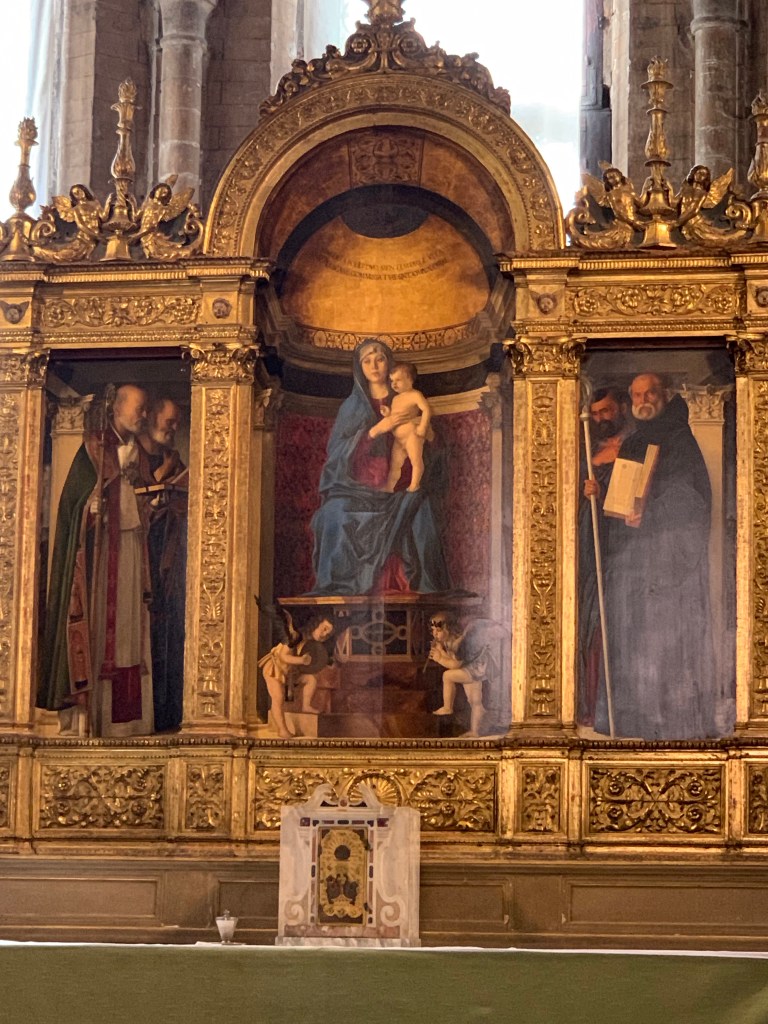
Unlike many churches throughout Europe, the churches of Venice have mostly retained their art.  Instead of sending or selling the art to museums (or allowing it to be taken, I suppose), Christian art can be appreciated in situ.  It’s a very different experience to consider paintings and art in their “natural habitat,” than to see them in a carefully designed museum exhibit.

After visiting several churches, I couldn’t help but to consider that the strong Protestant dictate to remove art and images from sanctuaries to be an unfortunate aspect of our protesting ways against Roman Catholicism.  Sure, there can be a sense of the art and the stuff of Roman Catholic sanctuaries that seems clearly to have gone too far.   It’s quite alarming, for instance, to encounter “relics” (pieces of saints or even drops of the precious blood of Christ) and tombs and entombed saints in glass. Yikes.

But, the art and the images were in many cases far beyond what mere words can describe or convey. In the Chiesa di San Polo, for example, an entire room is dedicated to a succession of paintings that depict the journey of Jesus from trial to crucifixion and then to entombment. It was an almost breathtaking experience to make my way around that room, gazing from painting to painting, considering the subject matter and focal point, and periphery, of each. While the story offered in words is powerful itself, it is extraordinarily different to appreciate the story through an artist’s eye.

In several churches, we were able to see works of a family favorite, Giovanni Bellini. It’s really Bellini who launched my daughter into a major in art history and now a second art museum internship. We, as a family, had visited a special collection of Bellini paintings in Rome in 2008 (because Margaret, at the age of 12, had become completely enchanted with the artist). But, in Venice, we were able to visit a few pieces, mostly in the form of Madonna and Child paintings, in various churches– where they belong.

Words are certainly important, and a significant dimension of our lives of faith. But, images are significant too, and not simply the images that we develop in our own heads. It’s worth reconsidering the role of art and images in our spiritual practice and in our worship. Images ought not only be relegated to the private. They ought to have a public place. Faith is not only an intellectual and mental enterprise. There is a dimension of faith, and the stories that help to frame and form that faith, that is enriched by art and images.

While I’m decidedly not going down the full Roman Catholic route, I think it’s time to bring back images and art. And, to bring them into a place of significance. We will not be able to gaze upon an original Bellini in our sanctuary in Hallowell, Maine. But, I have no doubt that there are other images, and pieces of art, that are worth bringing into our worship space– images that will enrich, challenge and enliven our faith.

Posted in Worship | Tagged , , , , , , | Leave a comment

A Whole New Awareness of the Challenges of Recognition

Many of the Gospel resurrection accounts include a failure of recognition.  Even some of Jesus’ closest friends do not recognize the Risen Christ at first.  Mary mistook him for the gardener, according to John, until he spoke her name.  In Luke, we have a rather strange story of two friends walking seven miles on the Sunday after the crucifixion, from Jerusalem to Emmaus, when Christ himself joins them along the way.   The two friends failed to recognize him until they sat down for a meal. 

I’ve discovered over the years, that these stories are more than disconcerting for the more or less doubting Christian.  Those who already have a hard time with resurrection are yet more unsettled by these stories.  How is it even remotely possible that those very close friends could not recognize him?

The Christian writer Frederick Buechner suggests that this lack of recognition may stem from difficulties in actually recognizing Jesus pre-crucifixion.  Though the friends spent time with Jesus, learning from him, talking to him and helping him, they somehow never truly allowed his presence to sink fully into their consciousness.  After the resurrection, no wonder they had difficulty in recognizing him.

I’ve always thought Buechner was on to something.  And I still do.  But, now I have another perspective.

Here’s a little background:  I’m in my mid-50s.  And like many women my age, I dye my hair to hide the steely grays that now grow out of my head.  I didn’t exactly set out to be a woman who dyed her hair, but I’ve had a long relationship with a great hairdresser.  Years ago, before the grays appeared, I started occasionally getting my hair highlighted.  These appointments were long ones and they became a sort of therapy session.  Highlighting then morphed into hair color and the more grays that appeared, the more often I had to go.  The coloring seemed a simple pathway to a more routine therapeutic relationship.

Originally, my hair was brown, so I stuck with brown, sort of, when it came to those first years of full coloring—but a darker brown, with reddish highlights. 

Last spring, I decided it was time for a change—lighter.  Much more blonde.  More fun, right?

What’s been fascinating since I changed my hair color is that lots of people don’t recognize me.  It’s been quite an eye-opening experience.  I ran into one young woman from church (who had not attended worship since before the hair color change) in the grocery store.  I said hello, she said hello back to me.  But, then when I ran into her a few aisles later, she said, “Oh, hi!  I just realized who you are.  I really didn’t when I saw you a few minutes ago.  You look different.”

Another time I was in a line at a shop and realized that the woman in front of me was someone I used to chat with at the gym all the time (I stopped going to that gym about a year ago).  When she turned around partway, I offered a cheery hello.  She looked at me, said an awkward hello back, scowled, and then turned around.  She clearly had no idea who I was.

These sorts of situations have been happening on a regular basis for the past several months.  And, this has given me a whole new appreciation for those first Easter stories where even those closest friends had a hard recognizing Jesus.  Well, of course they had a hard time.  Resurrection surely altered Jesus’ appearance, don’t you think?  And, it turns out that it doesn’t take much alteration before even close friends have a hard time in the recognition department.

This has led to a whole new set of wonderings around our ability to recognize the Divine presence in our lives and in our church.  Do we have the capacity, in our lives of faith, to be open to the surprising ways through which God joins us on the journey?  Are we able to allow ourselves to push aside our preconceived notions, and our stubborn desire to cling to what we know, to open our eyes afresh to the presence of Christ?

I now hold serious doubts.  My own experience suggests that recognition is a tricky, challenging business.  As we cling to what is comfortable and routine, we have little to no appreciation for how deep-seated those notions sit in our consciousness.

Familiarity has its place and it is no doubt significant in our lives of faith.  But, Jesus so often sought to upend familiarity, to show us that to be connected to God is to live in the midst of both familiarity and surprise.  If our lives of faith stay solidly in the realm of the familiar, then our lives of faith are seriously wanting.  We are called to open ourselves to recognition, and the first step is to recognize that we often have a very hard time in the recognition business.  Who knows who might be walking beside us or coming near enough to speak our name?

Posted in Uncategorized | Leave a comment

Lessons I Should Have Learned in Divinity School: Leadership in the Midst of Sunset

Thirty years ago (it’s hard for me to believe), I started divinity school.  On my three-year journey to a Master of Divinity degree, I took a great range of church-related/ministry-related courses—theology; ethics; Hebrew Scriptures; New Testament; Greek; church history; pastoral care and counseling; etc.  I never took a class on leading a church through its decline and very likely closure.  Not one.  I’m quite sure such a class didn’t even exist.  Because, well, who would sign up to take that sort of class?

I would—now.

Peruse some of the online homepages of publishing houses associated with various mainline denominations (Westminster John Knox, Cokesbury and the Pilgrim Press), and one will not see many featured publications on church decline and church closure—despite the fact that such a thing is taking place on a regular basis.  Instead, titles offer opportunities for new ways of doing things that will turn things around, away from death and dying of old mainline churches.

Yet, for many churches, the only path ahead is closure—and there are precious few resources to help those clergypersons (or lay leadership) who serve such churches.  In a theological system that is supposedly not fearful of death, it’s a sad commentary.  Churches on the brink of closure, and those that have closed, are left to their own devices in the matter of the sunset of a church.

Left on their own, lots of good church folk turn to less than positive responses to the demise of their beloved church.  After a UCC church in a town a few miles away from Old South closed about 7 or 8 years ago, a group of those church members came to Old South and eventually joined.  When I met with the group to talk about joining Old South, one of the women raised her hand and asked, “Are you sure you want us to join your church?  Our church failed.”  It was a heartbreaking moment.

Articles on church decline—how to identify the signs of a dying church, etc.—usually focus on the internal workings of the church, as if only church members are responsible for church decline.  Sure, there are some problematic behaviors of struggling churches—forgetting to unlock the front door on Sunday mornings (because “everyone” knows that they should enter through the side door, of course); telling visitors that they are sitting in the wrong place or they are doing something wrong; not speaking to visitors at all; etc. 

But, there are important forces outside of struggling churches as well, that must be recognized, and aspects sometimes of the building or community itself that are outside the control of the congregation.  Maine, for instance, is a tough place to be a Christian church—no matter what denomination or affiliation.

According to the Pew Research Center’s Religious Landscape Study (2016), Maine is tied for 48th place in the US in terms of religiosity.  Only 34% of residents feel that religion is “very important” and only 22% attend worship on a weekly basis.   These numbers are stunning, and humbling.  For struggling churches, these numbers may indicate a possible road to evangelism, since there are so many people who clearly are not attending church.  These numbers, though, indicate another important dynamic that cannot be denied or ignored:  a dramatic sea change in the lives that are lived in this part of the world.  The tide has turned, and it has turned against us. 

This hasn’t always been true, of course.  Town centers all around New England serve as collections of church buildings.  For those people who might be looking for a church home, there’s a lot of choice.  There just are not so many of those who are searching.

For the clergyperson who finds her/himself serving a small congregation with a physical plant that is too big and costly to maintain, it’s a daunting prospect not only to think about the sunset, but to outline a path through such a process.

At Old South, we may have a few options that will ease our way through.  We have a large endowment and we have a building that we may be able to share with others (although making one or both of our buildings share-able will require upgrades that will not be inexpensive).  But, we also have what can only be described as an “older” congregation.  The average age is now over 70.  And, with that, comes the sense of weariness regarding any major undertaking.

It seems clear enough that the path ahead involves confronting our decline and trying to figure out how we can maintain our mission in the midst of that decline.  Can we continue to be the best church we can be while facing fewer and fewer people to do the work of church?  And, how will the church tackle some of the most important of its decisions, like, what do we let go of first:  building or staff?  Can we continue to work together or will we fall into unhealthy and destructive habits, like pointing fingers in blame?

I wish I had something from my divinity school education that would inform my leadership during this time of sunset.  There must be ways of maintaining faithfulness even in the midst of our demise—just like in our human lives.  It shouldn’t have to feel shameful, as if we failed at being church—as long as we continue to be church and to hold our reason for being as a focal point, despite the diminishing daylight.

Posted in Should Have Learned in Div School | Tagged , , , , | Leave a comment

Living in the Midst of Dying

It’s a hard time to be a traditional Mainline church. It feels harder still to be a traditional church in a part of the world that often feels not only indifferent to organized Christianity, but sometimes even hostile. Such is life in Central Maine.

At Old South, we struggle with many issues, having to do with money, the maintenance of our buildings, the appropriate level of staffing, and our diminishing attendance numbers. Yet, there are ways in which the church not only clings to life, but seems to thrive.

Much of the thriving is related to mission. In recent years, Old South has become an amazingly generous church. Most of this generosity is related to money, and donations to various causes. But, the church has also managed to maintain a commitment to a monthly (except in the summer months) dinner that is delivered to a local homeless shelter. And, we host an annual after-worship potluck that offers information and discussion regarding important local needs, like food pantries and homelessness. This fall, we are organizing a program on immigrant needs in the area.

Another aspect of our thriving mission is the Outreach Fund and the diversity of “causes” for which we gather funds. We helped quite a few people (some young, some not so young) attend the Maine United Church of Christ-related summer camp this season. We’ve also provided assistance to various local organizations that help a whole range of people like those who are incarcerated in the county jail, veterans who are hospitalized, and survivors of domestic violence. And, we’ve reached out much further, giving to disaster relief in faraway places.

In the midst of our mission and outreach, though, we cannot escape the reality that we are a dying church. Our attendance numbers are in serious decline (one Sunday this summer we had an all-time record low in worship: 15). We are facing difficulties in paying bills on a more regular basis. And, we are well-aware of our failure to keep up with maintenance of our two buildings– the large, stone, steepled sanctuary building and the parish house across the street, that contains offices, Sunday School classrooms, and a kitchen.

How do we hold these two things together– a shrinking, dying church community on the one hand and on the other, a church that maintains a strong commitment to mission and outreach? We are already witnessing the first tears at the fabric of what we have become as church. One person has asked why we are not looking at the Outreach Fund as a way of easing the church’s financial difficulties. Another person has expressed distress at our seemingly wanton disbursement of cash, when we are not adequately “taking care of our own”?

So far, we are managing not only to keep up our mission and outreach, but we have expanded that outreach. The voices that suggest otherwise have not gained any traction. But, I cannot help but wonder how long this situation will hold.

As we continue to shrink, we face increasing pressure and, as well, the unsettling experience of church that none of us, not even me, are truly prepared to face: a church that is such serious decline that its closing is now clearly on the horizon, and a horizon that is not far away. While we wrestle with what to do about our buildings, and how to maintain staffing, will we be able to continue to remain committed to mission and outreach?

It’s a stressful time to be church, and to be a shrinking church. Will we, as a group, be able to resist the temptation to turn inward and to view the church itself as “mission”? Will we, as a church, realize that without a commitment to mission and outreach there really is no point of gathering at all?

Posted in Doomed | Tagged , , | Leave a comment

Mr. Trump, Evangelical Christians, and the Central Park 5

14With them indeed is fulfilled the prophecy of Isaiah that says:
“You will indeed listen, but never understand,
   and you will indeed look, but never perceive. 
15 For this people’s heart has grown dull,
   and their ears are hard of hearing,
     and they have shut their eyes;
     so that they might not look with their eyes,
   and listen with their ears,
and understand with their heart and turn—
   and I would heal them.” 
16But blessed are your eyes, for they see, and your ears, for they hear.17Truly I tell you, many prophets and righteous people longed to see what you see, but did not see it, and to hear what you hear, but did not hear it.

Matthew 13:14-17Whe

During my recent three-week vacation during the second half of June and into July, it took a bit of time to get accustomed to much less than normal access to news. My husband and I were on a ship exploring the islands off of Scotland, and then hiking part of the Speyside Way. For various reasons, news was often hard to come by. At first it was strange not to begin my day by reviewing several newspapers. Then, I discovered that I liked not knowing what was going on.

But, one piece of news managed to pierce the bubble, and that piece of news lodged itself in my brain. It didn’t appear to be a big piece of news, yet I found myself thinking about it over and over again: the Central Park Five and Donald Trump’s refusal to reflect even for the briefest of moments on his stance regarding this clear case of injustice. This was not only yet another moment of despair regarding the current President, but also one of those places where I was filled with profound anger and hopelessness for the silence of the evangelical Christian community.

If Donald Trump had had his way back in 1989, those young men would have been put to death—for a crime they did not commit. Shouldn’t such a story demand something of any faithful Christian—confession, grief, sorrow, a desire seek reconciliation, a promise to at least try to do better?

While the President makes me angry just about every day, and multiple times on many days, I continue to be especially perplexed and troubled by those evangelical Christians who support the President with such vehemence even in the midst of his wantonly un-Christian attitude and behavior. The case of the Central Park 5, brought back into our consciousness by the recent Netflix mini-series, When They See Us, is yet one more example of the President’s problematic perspective that should not be ignored by evangelical Christians.

The case of the Central Park 5 ought to inspire at least a bit of reflection—individually and collectively. Especially for Christians who speak the language of love, justice, hope, and reconciliation, it is vital to spend a moment considering this terrible episode, what led so many to assume guilt on the part of those young black men, the rush to judgment and then the stubborn inability to learn important and significant lessons once the truth finally became clear.

It is hard for me to accept that evangelical Christians will just heave this incident onto the now very large pile of un-Christian actions of the current President. That the President doesn’t even seem to accept the truth, claiming that the men “admitted their guilt,” is profoundly troubling (see story here). Such an attitude should simply be unacceptable to any person who claims to be Christian.

I have offered my plea in the past, begging evangelical Christians to demand more, and better, from this President. Not that I’m expecting any evangelical Christians to be reading this blog, but I’m not the only one who has pointed out these issues and problems in the relationship between basic tenets of Christianity and President Trump. Or, more precisely, the lack of relationship between basic tenets of Christianity and Mr. Trump.

Mr. Trump may be acting in ways that are and will be politically expedient for him and his hope for re-election. And, perhaps evangelical Christians are willing to turn a blind eye in favor of what they see as a path to greater and grander things. But, in that turning away, they are actually turning away from their faith in significant ways, allowing their hearts to grow dull.  The path to greater and grander things actually lies in the opening of our eyes, our ears and our hearts.  That is where there is understanding, healing, and the love that Christ promises.

Posted in Misc | Tagged , , | 1 Comment

A Few Thoughts on Buildings and Churches

During my recent vacation, my husband and I found ourselves with a few unexpected hours in Aberdeen, Scotland. While wandering around the city, we noticed a few church buildings (not really a surprise; we tend to notice church buildings everywhere we go). Like so many places around Europe, church buildings are in a clear state of transition—in the midst of the sharp decline in membership over the last half century. In Aberdeen, we noticed one church building that has been fully repurposed into a museum, another that is now a pub/party venue:

and another that has been developed into an office building,

I couldn’t help but wonder what my own church building will eventually be used for—event space? a residence? offices? another faith community? Or, will it stand abandoned and vacant, an empty shell of its former glory?

I’m mindful that the “church” is not really its building, that the faith community must see itself as the body of Christ, as the presence of Christ in the world, rather than wrapping its identity inside and around the physical walls and structure in which it has gathered. But, my recent vacation also reminded me of the “church” as a physical structure, a place with walls and a roof, a place of quiet and holiness.

Earlier in our trip, we visited the island of Iona and spent some time in the Iona Abbey. There is something both powerful and humbling in sitting in an old church building, a place with thick walls and a tall ceiling, with rows of seats and the artifacts of a worship life—an altar, Bibles, hymnals, worship books, etc.

Iona Abbey
Iona Abbey
Iona Abbey

We happened to visit Iona on a Sunday, which also just happens to be the only day of the week when there is no prayer service in the afternoon. I had to content myself with just being in the building. Still, it felt very much like a Sunday experience for me, a small moment of silent worship and praise.

Sure, it could have had my moment of Sunday worship and praise anywhere. But, I found that the building is not only a convenient and familiar place in which to which to lift up a bit of worship and praise. There is something about the building itself that evokes a sense of holiness, of wonder, of prayerfulness.

What happens when we at Old South can no longer sustain our building(s)? We may live on as church, in important and meaningful ways, but we will also miss something significant to our lives of faith, in the loss of the building in which we worship.  And perhaps more than that.

At Old South, we already spend a couple of months each winter worshiping outside of the building, gathering for Sunday worship in our parish house. Over the years, we have learned that there are pros and cons to this transition. In moving to our other building, we lose the threat of slipping on an icy road (the parish house, across the street from the church building, is closer to the parking area). We also lose the organ and the pulpit, as well as the large setting in which the small congregation tends to spread from one side to the other. The parish house may feel less “church-like,” but there are benefits beyond accessibility:  we have a closer experience and even when our worship attendance is low, we don’t feel small.

My experience in Scotland reminded me that the building is not simply for the community that gathers within it. Church buildings are for others as well. As church membership declines at a remarkably rapid pace and as church buildings are repurposed into spaces that are not connected to religious practice, will the community at large find that we have lost something precious and valuable?

Perhaps a wee bit of hopefulness can be found at Iona, where the first wave of Christianity gained a foothold in 563.  Through great toil and struggle, Christianity has been a part of Iona on and off through these many hundreds of years.  Among the Christians that have found a home on Iona were Celtic Christians, Benedictines and since the 1930s, an ecumenical group of Christians known as the Iona Community.  The Abbey Church has experienced both a strong sense of place and connection, with active worship, as well as complete abandonment.

In all of this, what seems important is to remain tethered to our purpose and our lives of faith, to do our best to refrain from overwhelming worry and concern about the future, and quite simply, to trust, to trust in the work of the Spirit in our midst.

Iona
Iona
Posted in Uncategorized | Tagged , , , , | Leave a comment